Addition to 10 — Exercises and Games for Preschoolers (Ages 4–6)
Simple, effective addition-to-10 exercises for children aged 4-6. Games with blocks, fingers and everyday objects that really teach.
Addition to 10 is the first and most important step in learning maths. If your child masters it solidly, everything that follows — addition to 20, to 100, subtraction — becomes easier. The good news: at this stage you don't need worksheets or "lessons." Blocks, fingers, dice, and a few minutes of play a day are enough — a hands-on, playful start is exactly what early-childhood educators recommend³. Below you'll find eight proven exercises, the three stages every child goes through, and how to talk and praise so counting becomes a habit.
Before You Begin — What Should Your Child Already Know?
Before addition to 10, your child should comfortably count to 10 (forward and backward), understand that a number represents quantity (not just a word in a rhyme), and be able to respond to "give me 4 blocks" — connecting number to concrete objects. It also helps if, over time, they recognise small groups "at a glance": that three dots are three, without counting one by one. That skill (called subitising) makes addition much easier.
If any of these isn't yet solid — start there. Count objects at home, on walks, at the store. This is the foundation without which addition doesn't make sense, and building it takes a week, not a year.
How children learn to add — from concrete to "just knowing"
Addition isn't taught "by heart" — it's built gradually, from action to symbol. Through the counting stages described in the research on early number learning¹, children pass through three phases:
- Counting all. The child has 3 blocks and 2 blocks and counts from the start: "one, two, three, four, five." The most basic, concrete way.
- Counting on. The child begins from one number and counts on the other: "three… four, five." This already saves work — especially when starting from the bigger number.
- Knowing from memory. Eventually the child simply knows that 3 + 2 is 5, without counting.
Each stage is needed and none can be skipped. That's why we start with objects a child can grasp — the hand and eye do work the head can't yet manage with symbols alone². We introduce "3 + 2 = 5" only once the child can "see" real blocks behind it.
What to have on hand — a little counting kit
You don't need to buy anything — things from around the house are enough, as long as a child can grab and move them:
- A handful of counters — blocks, buttons, pasta, coins. Anything you can arrange into piles and count.
- Two dice — a ready-made problem generator.
- A deck of cards (values 1–10) — for sum games.
- Paper and crayons — for drawing sums and first written attempts.
- A cup or box — for hiding and guessing "how many are missing."
Keep them together in one box, within reach. The lower the barrier, the more often you'll reach for five minutes of play instead of a worksheet — and it's regularity, not length, that makes the biggest difference.
Exercise 1: Two Piles of Blocks
The simplest and most effective exercise. You need 10 blocks (or buttons, coins, chestnuts).
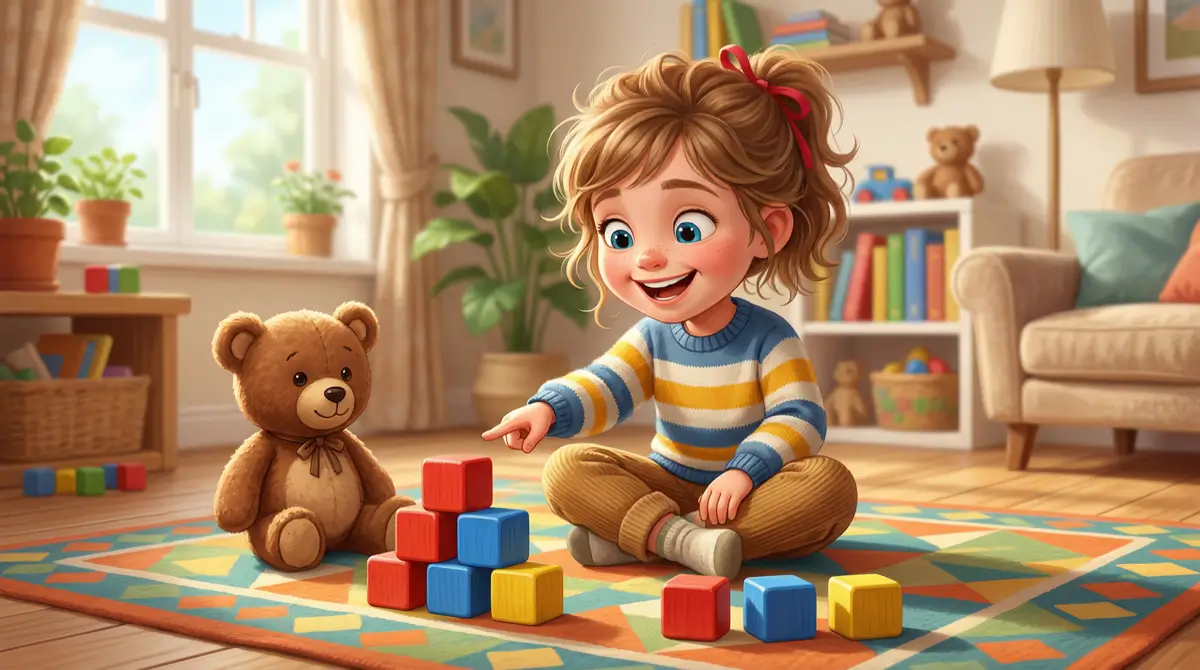
Place 3 blocks on the left and 2 on the right. Ask your child: "Count how many are on the left. Now the right. Now count ALL of them together." The child moves blocks one by one and counts. That's addition — physical, tangible, understandable.
Gradually change the numbers: 4+1, 2+3, 5+2, 1+6. Always within 10. Once your child counts confidently, offer a trick: "start from the bigger number" — for 2 + 6 it's easier to say "six… seven, eight" than to count everything from two. A closing variation: show one pile and give the total — "there are 3 blocks here, and 8 in all, how many did I hide?" This gently introduces the "missing part" and subtraction, without naming it yet.
Exercise 2: Adding on Fingers
Show your child 4 fingers on the left hand and 3 on the right. "How many fingers do you see altogether?" The child counts all fingers — 7. Simple, always available, and kids love it.
Advanced version: "Show me 3 + 5 on your fingers." The child has to decide how many fingers to show on each hand. Counting on fingers is a natural and healthy developmental stage — don't forbid it; a child drops it on their own once mental strategies become faster.
Exercise 3: Dice
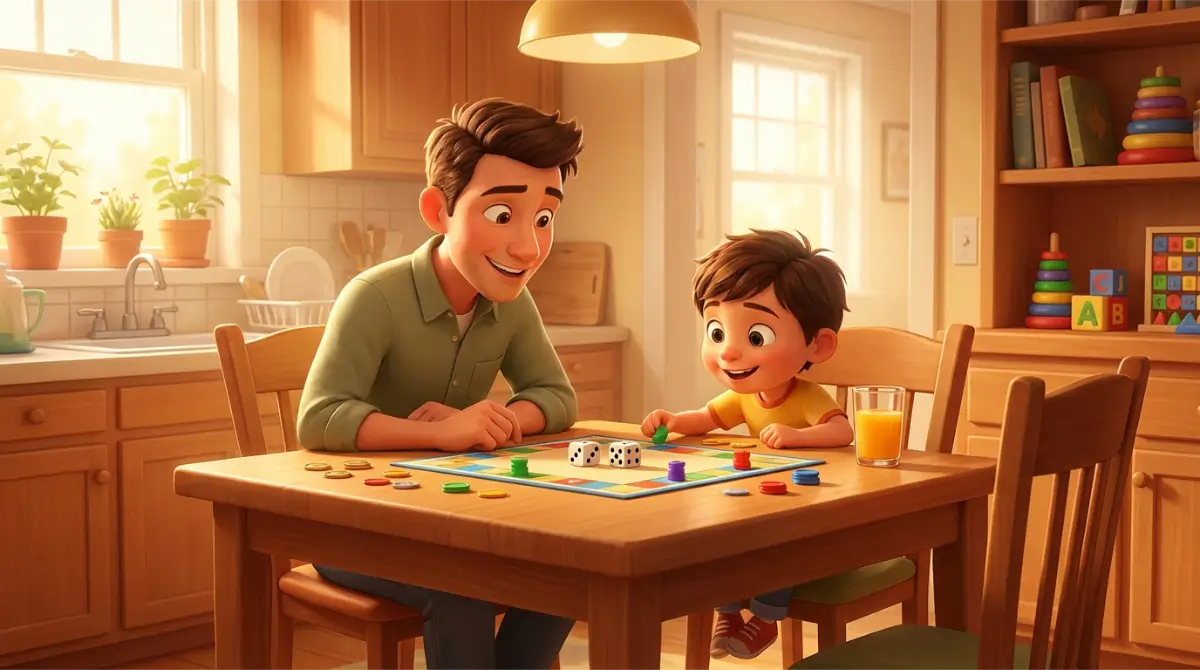
Two dice are the best generator of addition problems (up to 12). You roll, the child adds the dots. Whoever calls the answer first wins a point. You can limit the range: cover sides 5 and 6 on both dice with tape — then the result never exceeds 8. Perfect for starting out. Dice also build subitising: over time a child "sees" five dots without counting.
Exercise 4: "How Many Together?" on Walks
Every walk offers plenty of chances. "2 pigeons on the roof and 3 on the pavement — how many altogether?" "1 lady on the bench, 2 gentlemen arrive — how many people on the bench?" The child learns that maths is everywhere, not just in a workbook — and that numbers are useful.
Exercise 5: Drawing Sums
Give your child paper and crayons. "Draw 3 suns and 4 clouds. How many did you draw?" It combines creativity with maths and works especially well with children who love drawing. The drawing stays — the child sees their "sum" and happily makes another.
Exercise 6: Dominoes
Classic dominoes are pure addition. Each tile has two sides with dots: "How many dots are on this tile altogether?" It's addition practice (up to 12) in game form, with zero effort. Dominoes also teach comparison — which tile has more.
Three more games to rotate
To keep it fresh, have a few variants:
Cards for the sum. Deal one card each (values 1–5). Each player flips their card, and the child adds both and says the sum. First to answer takes the pair. The element of chance is motivating on its own.
The money jar. Drop "coins" into a jar a few at a time: "two… and three more… how many inside?" The satisfying clink and the "growing" jar turn counting into play.
Sum tower. Build a tower together: the child adds "two blocks… and three more" and says how many storeys it has. A rising tower invites the next addition — and teaches that the order of adding doesn't change the total.
Partners of ten — pairs that make 10
There's one exercise that pays off most: pairs of numbers that make 10. 1 and 9, 2 and 8, 3 and 7, 4 and 6, 5 and 5. When a child knows these by heart, later addition across the ten (8 + 5) becomes much easier — and the same goes for subtraction.
Practise it with real objects: take 10 blocks, hide some in your hand, and the child guesses how many are missing to make ten. Or arrange 10 into two piles in different ways and name the pairs. It's a short game, but it builds the foundation for all of maths to 20 and beyond.
Addition in everyday moments
The best practice often happens in passing. Setting the table: "there are 3 plates, add 2 — how many now?" In the kitchen: "we have 4 apples and bought 3 — how many altogether?" While tidying up: "2 blocks here, 3 there — how many go in the box?" In the car, count things you pass "and one more."
These micro-questions, woven through the day, do more than one long session — because the child sees that numbers are useful. The key is a light tone: ask out of curiosity, don't "test." If your child isn't in the mood, let it go and come back another time. And now and then, swap roles — let the child set a problem for you. Inventing problems is a sign they understand addition, not just compute it.
How to talk and praise during practice
Words matter. Name the action: "we add three… let's count together." Praise the method, not just the right answer: "clever, you counted on from the bigger number." Don't supply the answer straight away — the silence while a child thinks is valuable; count to five in your head before helping. When they slip, don't say "wrong"; count it again together on the blocks. Keep the tone light: this is playing with numbers, not an exam. That attitude is exactly what makes a child want to come back to counting.
Common mistakes and how to respond
- Counting everything from one every time. This is a normal early stage, not a problem. Over time, gently show "counting on" from the bigger number.
- Rushing to written notation. The symbol "3 + 2 = 5" only means something once the child sees blocks behind it. Concrete first, then symbols.
- Numbers too hard to start. Begin with sums to 5–6, only then to 10. Success on the easier builds appetite for the harder.
- Pressure and comparison. Discouragement blocks learning more than a missing skill does. Keep it short, calm, and daily.
How much and how often to practise
At this stage it's rhythm that counts, not length. Five to ten minutes a day in a good mood beats an hour once a week. It's best to weave counting into what you're already doing: breakfast, a walk, bath time, the way to preschool. A four-to-six-year-old has a short attention span, so stop before they get bored — leave them wanting the next round.
A day off spoils nothing; what matters is that playing with numbers is a steady, pleasant part of the week, not a chore. And don't worry if a child "knows it" one day and seems to forget the next — that's what normal learning looks like. Short, regular practice makes the answer eventually "click" for good.
When your child finds it hard
If you see discouragement, drop the numbers lower (to 5) and go back to counting with objects — no rush, no competition. Choose cooperative games where you "win together," and set the level so success comes often. Name the feeling, too, instead of ignoring it: "I can see this is tricky right now — let's do an easier version." The child then feels understood rather than judged, and is readier to try again. A short, successful game once a day does more than a long, frustrating session now and then.
When to Move to Addition to 20?
In most early-elementary curricula, addition and subtraction within 10 are the foundation of the first year — but many children get comfortable with them already in preschool. Your child is ready for addition to 20 when they answer questions like 6+3, 4+5, 7+2 without hesitation. They don't need to count on fingers — they just "know" the answer. That's the sign addition to 10 has been internalised.
Don't rush. Better to spend three weeks on solid addition to 10 than to skip ahead to 20 after three days. Order beats pace: a skipped brick shows up a floor higher.
Why it pays off later
Addition to 10 can look like a "small" skill, but all of later maths sits on it. Confident sums to 10 are a precondition for adding across the ten (8 + 5), and the same "partners of ten" return in subtraction, in numbers to 100, and even in multiplication as repeated addition of equal groups. So a few weeks of calm play with addition to 10 is one of the best investments in a child's mathematical future — a solid foundation saves a lot of tears over harder topics later.
Addition to 10 with EduBert
Short daily practice works best — and it's easier to keep up when it feels like play. In The Park Adventure, children practise addition as picture-based tasks: the first levels are addition to 10, on small numbers, with immediate feedback. Difficulty rises gradually across ten levels, so a child moves smoothly from sums to 10 toward bigger numbers. Level 1 is free, so you can create an account and see whether the format suits your child. Want to meet the characters your child will encounter along the way? See meet the Park adventure characters.
Frequently asked questions
From what age should we teach addition to 10? Usually between ages 4 and 6, but that's a rough guide. More important than age is that a child counts confidently to 10 and understands that a number means a quantity. Then addition with objects makes sense.
Is finger counting okay? Yes. Fingers are a natural, concrete model of number and a good learning stage. A child drops them on their own once mental strategies become faster.
How long should we practise each day? Short and regular wins — a few minutes a day as play beats long, infrequent sessions.
My child counts everything from scratch — is that a problem? No, it's a natural first stage. Over time, show "counting on" from the bigger number; it comes when the child is ready.
Worksheets or play? At this stage, hands-on play is more effective. Worksheets can come later, once addition is understood.
How do I know we can move to 20? When the child answers sums to 10 without counting — they "know" them. Then the tens threshold in addition to 20 will be a natural next step.
Do I need ready-made aids or an app? Not to start. Blocks, fingers and dice are enough for dozens of games. An app or ready-made games can be a nice extra later, once the child already understands what addition is.
Should I teach subtraction alongside addition? At first, focus on addition, but calmly show "how many are left" when you take something away. The child will notice that adding and taking away are two sides of the same number play.
Addition to 10 needs no workbook and no pressure — blocks, fingers and five good-humoured minutes a day are enough. Pick one exercise from the list and start today. And when you'd like your child to practise addition independently, at the right level, try the Park in EduBert — the first level is free.
Sources
- National Research Council, "Adding It Up: Helping Children Learn Mathematics," National Academies Press: nationalacademies.org — the counting stages (counting all, counting on, recall) and conceptual foundations of early addition.
- The importance of the CPA approach in the early years, Maths — No Problem: mathsnoproblem.com — concrete → pictorial → abstract as the route to understanding.
- NAEYC, "The Beauty of Early Childhood Mathematics: Playful Math = Engaged Learning": naeyc.org — the case for playful, hands-on mathematics in the early years.

Written by the EduBert team
We create educational games that combine play with learning math.
Read also
How to Teach Your Child Addition — Calmly and Without Tears
Teach your child addition step by step: from blocks to mental math, three strategies that make the difference, and how to practice without pressure or tears.
Addition to 20 (Crossing Ten) — When Is Your Child Ready and How to Teach It
Addition to 20 across the tens threshold: how to spot your child's readiness, the making-ten method, and worked examples (8 + 5, 7 + 6).
Addition Games at Home — 8 Ideas With Nothing to Buy
Simple, proven addition games you can make at home with dice, cards and cups. Zero prep, maximum fun and learning for kids aged 5–7.

Try EduBert together
Create a free account and let your child explore — the first level of every adventure is free.
Create free account →No card required — 4 adventures and the Training Meadow