Counting on Fingers — Bad Habit or Natural Stage?
Should you let your child count on fingers? What research and teaching say, when it's completely normal, and when it's worth gently paying attention.
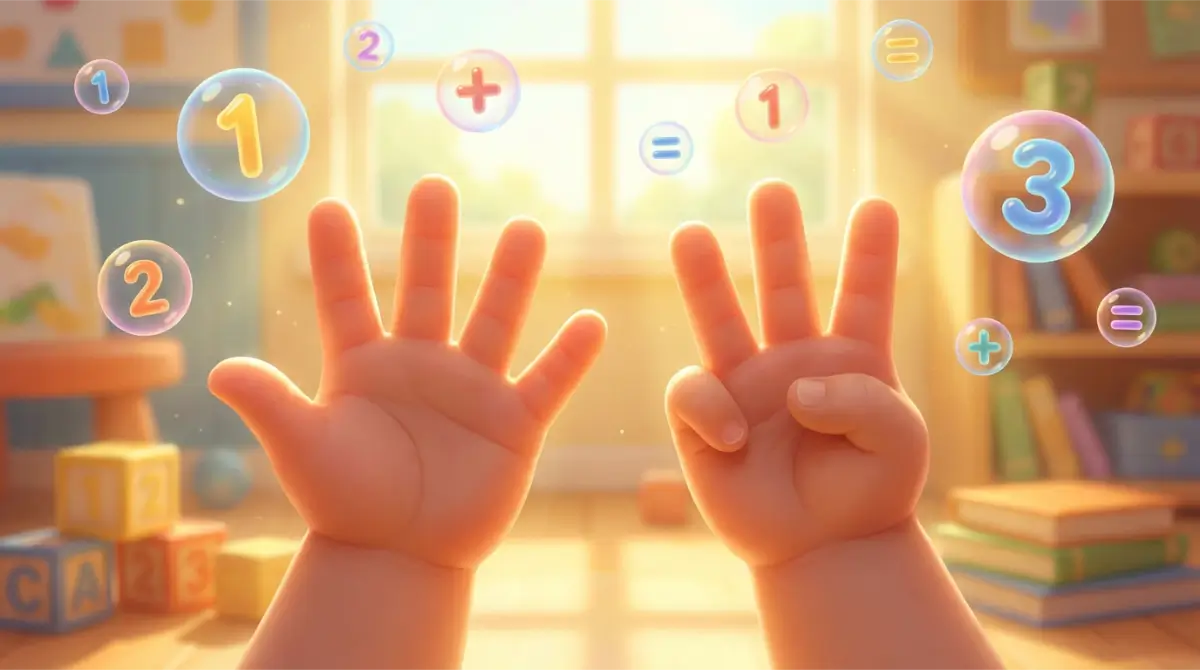
"Don't count on your fingers!" — how many times did you hear that in school? Or maybe you say it to your own child? The good news is that modern maths teaching says the opposite: counting on fingers is a natural and valuable stage of learning, not a bad habit to stamp out. Below we explain why fingers help, when it's completely normal, when it's worth gently paying attention, and how to calmly help a child move from fingers to counting in their head.
What Does Research Say?
Researchers — including Jo Boaler's team at Stanford — have shown that finger perception, how well we sense and represent our own fingers, is closely linked to numerical skill, and that using fingers supports rather than hinders learning¹. Fingers are a natural mathematical tool: a child always has them, there are exactly 10 of them (perfect for the range where learning begins), and they can be seen, moved, and counted all at once.
Using fingers engages brain areas responsible for both movement and number processing — that's double stimulation, not a double problem. In short, "don't count on your fingers" is advice with no backing either in good teaching or in how a child's brain actually learns.
Where the "don't count on fingers" myth came from
So where did the school-yard "don't count on your fingers" come from? For years, the goal was confused with the route. The goal — fluent mental arithmetic — obviously matters, so teachers wanted children to get there faster. The trouble is they tried to achieve it by banning the very route that leads there.
It's a bit like forbidding a child to steady themselves while learning to ride a bike because "they should ride on their own." The effect is often the opposite of what's intended: a child deprived of the concrete doesn't count "faster in their head" — they just make more mistakes and lose confidence. We now know that rushing toward abstraction, skipping the concrete stage, is one of the more common causes of difficulty with maths.
Why Does a Child Count on Fingers?
Because they need something concrete. Abstract maths — symbols on paper — is the destination, not the starting point. Fingers are a bridge between the physical world (things you can grasp) and the world of numbers. Reviews of early number learning link finger use to stronger numeracy², and the reason is simple: under the concrete → pictorial → abstract path, a child has to count "on something" many times before a number becomes an abstract idea. Fingers are that "something" — the handiest, because they're always available.
A 5–6-year-old counting 4 + 3 on fingers is doing exactly what they should — passing through the concrete stage before reaching abstraction. That isn't "cheating," it's learning.
Fingers Are More Than a "Counter"
You can do far more with fingers than count "one at a time." A child can show a number at once (a whole hand is five, without counting finger by finger) — which trains "seeing" a number, or subitising. They can break a number into parts: 7 is a full hand and two fingers of the other, so 5 and 2. And they can practise pairs that make 10: show 6 fingers and ask "how many are hidden?"
Research on fingers in arithmetic makes exactly this distinction — between using fingers to structure numbers and merely to count them one by one³ — and it's the structuring that builds real understanding. These finger games build precisely the skills — number decomposition and partners of ten — that later underpin addition across the tens threshold. Fingers aren't a "lesser" stage than mental arithmetic; they're the stage that prepares it.
Finger games worth showing
Here are a few simple games that use fingers wisely — not for tedious "one at a time" counting, but to build a picture of number:
- Flash and hide. Show a number of fingers for a moment, then hide your hands. "How many did you see?" The child learns to recognise a number without counting.
- Show it two ways. "Show me 6 — now differently." 6 is three and three, or five and one. The child discovers a number has many "faces."
- How many hidden? Show some of your ten fingers. "How many are hidden?" This practises pairs that make 10.
- Finger addition. "Show 4 on one hand and 3 on the other — how many altogether?" A classic that always works.
- Race the memory. You say a problem, the child answers; sometimes let them use fingers, sometimes "try it in your head." No pressure, taking turns.
- Make it ten. You show some fingers, the child adds the rest up to a full ten. Great preparation for the tens threshold.
Every one of these works in a queue, in the car, or at the table — with no props beyond your hands.
When Is It Normal?
Finger counting is completely normal and healthy at ages 4–7, especially with new, harder tasks. What's more, even a child who knows sums to 10 by heart will return to fingers for harder problems — for example, addition to 20 — and that's fine too.
Fingers are like training wheels: we use them where things are new and hard, and set them aside where we already feel confident. A child drops them on their own once mental strategies become faster — as long as no one bans fingers "by force." In other words, it isn't the calendar that decides when to set fingers aside, but a particular child's readiness — and that comes once the foundation, number bonds to 10, is secure.
When Should You Pay Attention?
A signal to look closer is when a child aged 8–9 still counts simple problems (like 3 + 2) on fingers that they should already know by heart. It may mean the basics haven't been internalised, and it's worth calmly returning to addition-to-10 exercises.
A note: this is no cause for panic or shaming. Such a signal is an invitation to return to the foundations — number bonds to 10 — not to ban fingers. A ban usually makes things worse: the child keeps counting, just hides their hands under the table and learns to be ashamed of something natural.
How long does the "finger stage" last?
There's no single answer — for some children a few months, for others a year or two, and both are within the normal range. How long it lasts depends on how many chances to count with concrete things a child gets day to day, and on whether anyone makes fingers a problem.
Paradoxically, the less we push, the sooner a child sets fingers aside — because counting feels like play and success, not stress. Your job isn't to "shorten" this stage but to make sure it's rich in the concrete and free of pressure. The rest comes on its own.
How to Help Your Child Move from Fingers to Memory
Don't forbid — build bridges instead. After the child counts on fingers, ask: "What if you didn't have fingers — how much would 4 + 3 be?" The child will start trying from memory, because it's a challenge, not a ban.
Practise pairs that make 10 and number decomposition, too — once a child "knows" that 6 is 4 and 2, they answer without fingers more and more. Games with light time pressure ("who says the answer faster?") naturally motivate mental arithmetic, because fingers are simply slower. And praise every time the child counts in their head: "oh, no fingers that time!" A change that gets noticed motivates more than any ban.
It also helps to separate "I'm counting because it's hard" from "I'm counting because it's faster": with a new type of problem, fingers are perfectly fine, while with well-known sums it's worth gently encouraging memory. Don't draw the line rigidly — watch where the child is confident and where they still need support.
What not to do
- Don't forbid. A ban doesn't speed up learning — it slows it down and adds stress.
- Don't shame. "Big kids don't count on fingers" is a sentence that stays in a child's head for years.
- Don't compare. A classmate counting in their head doesn't mean your child is "behind" — every child has their own pace.
- Don't quiz under pressure. "So what is it?!" in an exam voice blocks thinking. Better to weave counting into play.
What if you count on fingers yourself?
Many parents, on hearing "don't count on your fingers," recall their own schooldays — and sometimes quietly work out change on their fingers at the shop. There's nothing wrong with that. Fingers are a tool adults use too, when they want to be sure.
So if you catch yourself "leaning" on your fingers, show it to your child without embarrassment. "See, I check on my fingers sometimes too" takes needless pressure off counting and shows that maths is for people, not against them. A child who isn't afraid of a mistake or of a "childish" way of counting learns faster — because they try more boldly.
Fingers and crossing ten
Fingers show the "making ten" method beautifully. For 8 + 5, a child raises 8 fingers, adds 2 to make a full ten (all fingers up), and sees that 3 of the five are left — so 13. That's exactly the mechanism we describe in our guide to addition to 20 across the tens threshold. Fingers don't clash with "real" maths — they show it, step by step, in a way a child can see and feel.
Fingers work for subtraction too
Fingers work both ways. For subtraction, a child raises as many fingers as the starting number, folds down as many as they take away, and what's left is the answer. For 7 − 3, they raise seven fingers, fold three, and count four. The same "finger" model shows addition and subtraction as two sides of the same thing — which helps a lot when a child begins to connect the two operations.
What else helps besides fingers
Fingers are the handiest because they're always with us, but it's worth adding other concrete tools too — a child then builds a richer, more flexible picture of number:
- Blocks and counters — for arranging and counting piles.
- A ten-frame (two rows of five) — great for showing "how many more to ten."
- A number line — addition as a jump right, subtraction as a jump left.
- Dice and cards — for quick, random problems.
The point is for the child to see the same idea (say, "6 is 4 and 2") in several ways. Then understanding stops being tied to one tool — including fingers — and moves into the head more and more easily.
Counting on Fingers and EduBert
Short daily practice works best — and a tool with immediate feedback helps a child gradually automate answers. In The Park Adventure, children practise addition as picture-based tasks over a rising range of numbers; the quick feedback means that over time they reach for the answer "from memory" more and more, rather than their fingers. Level 1 is free, so you can create an account and see whether the format suits your child. This kind of practice doesn't replace playing with a parent — it supplements it when you don't have time to sit down with blocks. You'll find the whole addition journey in our guide on how to teach addition, and a child can practise any operation in their favourite format on the Training Meadow.
Frequently asked questions
Does counting on fingers do harm? No. It's a natural, valuable stage of learning — a bridge between the concrete and the number. What does harm is banning it, because that adds stress and shame without speeding learning up.
Up to what age is finger counting normal? Usually to around ages 6–7 for typical problems, and with new, harder tasks even longer. These are rough guides; pace varies, and that's normal.
My 8-year-old counts simple problems on fingers — what should I do? No panic and no ban. Go back to the foundations: number bonds to 10 and pairs that make a ten. Once those become a habit, the need for fingers on simple sums fades on its own.
Will banning fingers speed up learning? No — it usually slows it down. The child counts anyway, just in hiding, and learns to feel ashamed. Better to build bridges to mental arithmetic than to set bans.
How do I encourage counting in the head? With challenge-questions ("and without fingers?"), practice of pairs to 10, and short timed games. And praise every "from memory" answer — a noticed change motivates most.
Do fingers help with crossing ten? Yes. Fingers show "making ten" clearly (8 + 5: two fingers to a full ten, three left). That helps rather than hinders.
Are fingers useful when writing sums in a workbook, too? Absolutely. A child can work out the answer on fingers and then write it down. In time, writing and memory "catch up" with fingers — not the other way round. A ban at this stage only gets in the way.
Are there children fingers don't help? For most children, fingers are natural support. If, despite practice, a child struggles long and clearly with counting, it's worth talking to the teacher or a specialist — sometimes an assessment for a maths learning difficulty helps. Fingers aren't the problem then; they're one of the tools of support.
Let your child count on fingers. It's not a habit to eradicate — it's a stage to pass through. Forbidding it is like forbidding crawling because a child "should be walking already." Patience, concrete tools, and gradual challenges will do the rest. The most important thing you can give a child at this stage is calm: the certainty that counting — fingers included — is fine, and the answer will come in its own time. And when you'd like your child to practise addition independently, at the right level, try the Park in EduBert — the first level is free.
Sources
- Boaler, J., et al., "Seeing Is Achieving: The Importance of Fingers, Touch, and Visual Thinking to Mathematics Learners" (Stanford / youcubed): researchgate.net — finger perception and its link to numerical development.
- "You Can Count on Your Fingers: The Role of Fingers in Early Mathematical Development": researchgate.net — a review of how finger use supports early number learning.
- "Structuring versus counting: critical ways of using fingers in subtraction," ZDM – Mathematics Education (2018): link.springer.com — using fingers to structure numbers, not merely to count them.

Written by the EduBert team
We create educational games that combine play with learning math.
Read also
How to Teach Your Child Addition — Calmly and Without Tears
Teach your child addition step by step: from blocks to mental math, three strategies that make the difference, and how to practice without pressure or tears.
Addition to 10 — Exercises and Games for Preschoolers (Ages 4–6)
Simple, effective addition-to-10 exercises for children aged 4-6. Games with blocks, fingers and everyday objects that really teach.
Educational Games for Kids — Do They Really Work? What Research Says
What research says about educational games: when they help kids learn math, how to spot a good one, and how much screen time is too much.

Try EduBert together
Create a free account and let your child explore — the first level of every adventure is free.
Create free account →No card required — 4 adventures and the Training Meadow