Addition to 20 (Crossing Ten) — When Is Your Child Ready and How to Teach It
Addition to 20 across the tens threshold: how to spot your child's readiness, the making-ten method, and worked examples (8 + 5, 7 + 6).
Addition to 20 is a turning point in maths — the moment crossing the tens threshold appears. 8 + 5 = 13, but where does that "1" at the front come from? The easiest way to show it is in two steps through the nearest ten: first make ten, then add the rest. For 8 + 5: 8 needs 2 to reach ten, that leaves 3, so 10 + 3 = 13. The one prerequisite is secure number bonds to 10 — once a child knows the "partners of ten," this becomes almost automatic. Below: how to spot readiness, three proven methods, common mistakes, and how to practise.
When Is Your Child Ready?
Readiness for addition to 20 depends not on age but on mastering addition to 10. In most early-elementary curricula, adding across ten is first-year work, so if your six-year-old isn't there yet, that's completely normal.
There are three simple signs a child is ready: they answer within 10 quickly and confidently (without counting on fingers every time), they understand that 10 is a "full ten," and they can count on from any number up to 20. If one of these is missing — go back to addition-to-10 practice. There's no rush; a solid foundation matters more than speed.
Why crossing ten is hard
8 + 5 looks innocent, but it asks several things of a child at once: splitting one number into parts, reaching a full ten, and adding the rest — all held in the head. That's three operations where addition within 10 needed just one. On top of that comes place value: where does the "1" at the front of 13 come from? Obvious to an adult, but a brand-new idea to a child — that a number can mean "one ten and three ones."
So at the threshold it's worth slowing down and giving more concrete support than usual. It isn't a sign the child "can't do it" — it's a sign the topic really is harder and needs time.
Before you cross: show it with real objects
Before a child counts "in their head," let them see making-ten with objects — the concrete → pictorial → abstract path¹. The best tool is a ten-box (an egg carton, or a drawn 2×5 grid). Put in 8 counters. "How many more to fill the box?" — 2. "We have 5 more: put 2 in — the box is full! 3 are left. How many altogether?" — 13.
Physically placing the counters makes "making ten" tangible, and place value visible: a full box is one ten, the loose counters are ones. This stage looks slower, but it's what builds understanding. Skip it too fast and the child starts guessing. Only after a few of these demonstrations move to a drawing (a jump right on a number line), and finally to the bare notation.
What to have on hand
You don't need to buy anything to practise the threshold — things from around the house are enough:
- A ten-box (an egg carton) or a drawn 2×5 grid — the heart of the "making ten" method.
- A handful of counters — blocks, buttons, pasta — to put in and count on.
- A number line on paper, or tape on the floor you can hop along.
- Dice and cards 1–10 for quick, random problems.
- Paper, to jot the "branch" and check the answer.
Keep them together in one box — the lower the barrier, the more often you'll reach for a quick game instead of a worksheet.
Method 1: making ten
This is the most effective and most widely recommended strategy², and its heart is one question: "how many more to reach ten?" We split the second number into the part that fills to 10 and the remainder.
Example 8 + 5:
- 8 needs 2 to reach ten. Take 2 from the five: 8 + 2 = 10.
- Of the five, 3 are left.
- 10 + 3 = 13.
Written out: 8 + 5 = 8 + 2 + 3 = 10 + 3 = 13. A child who knows number bonds to 10 does this naturally. That's exactly why it pays to master "partners of ten" first.
Method 2: the number line
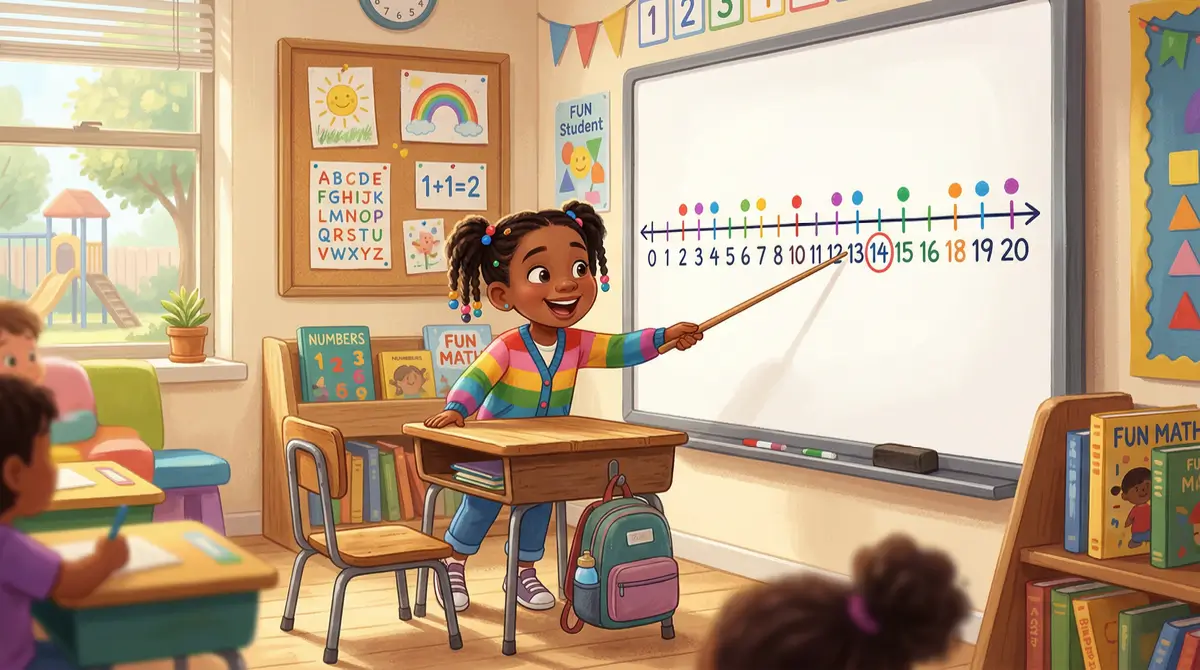
Draw a line from 0 to 20. The child puts a finger on 8 and "hops right" by 5 — first two steps to a full ten, then three more. The line makes addition visible: you can see we jump through the ten as a "stop." It's the same idea as the box, in the form of movement. For children who like to move, draw a big line on the floor and hop along it — the direction "right" then lives in the body. On the line, 9 + 4 looks like this: one step from 9 to ten, then three more — the finger lands on 13.
Method 3: breaking into two "packets"
Sometimes it's handier to split the added number differently. 7 + 6: break 6 into 3 and 3. Now 7 + 3 = 10, then 10 + 3 = 13. The child learns to flexibly decompose numbers — a skill that pays off across all of maths, from multiplication to column arithmetic. Show different routes and let the child pick whichever is clearest.
Which method to choose
There's no "one right" method. Making ten is the most universal, and it's the one to start with. The number line helps children who need a picture and movement. Breaking into packets can be quickest when the numbers are close (like 7 + 6, 6 + 7). Show all three and watch which one the child reaches for on their own — that's their natural way of thinking, and it's the one to strengthen. Choosing their own strategy itself builds the sense that maths is something to understand, not just perform.
First, the foundation: number bonds to 10
The whole threshold rests on a single skill — instantly knowing what a number is "made of." 10 is 8 and 2, 7 and 3, 6 and 4. When a child knows these pairs without counting, making ten happens by itself. Practise them with real objects: split 10 blocks into two piles in different ways, use dice, use hands (two hands make 10), use the ten-box. This seemingly "small" exercise is the most important investment before the threshold — without it, a child works out every problem "the long way" and tires fast.
Notation that helps
A young child easily loses the in-between result, so it's worth writing the two steps down rather than holding everything in memory. The simplest way is to draw a little "branch" under the added number: under the 5, write 2 and 3 (how much fills to ten, and how much is left). Now the whole route is visible: 8 + 2 = 10, then 10 + 3 = 13.
This isn't "cheating" — it's a support for memory the child will drop on their own in time. Early on, say and write in parallel: "make the ten… three left… add three." With the steps visible on paper, the child doesn't have to hold it all in their head and can focus on understanding rather than juggling numbers.
A few more worked examples
The more you practise together, the more it sticks. Split each through the ten — the make-ten first, then the rest:
- 9 + 4: 9 needs 1, 3 left, so 10 + 3 = 13.
- 7 + 6: 7 needs 3, 3 left, so 10 + 3 = 13.
- 8 + 7: 8 needs 2, 5 left, so 10 + 5 = 15.
- 6 + 8: easier to start from the bigger number (8 + 6): 8 needs 2, 4 left, so 10 + 4 = 14.
Notice the repeating rhythm: "how far to ten?" then "how much is still left?" When your child starts asking those two questions unprompted, they're well on their way. Don't correct every step — let them finish, then catch any slip together.
Common mistakes and how to respond
- Counting on from the wrong number. A child says "8 + 5 = 12," counting "eight" as the first step and adding only four. Return to blocks and physical moving; count aloud "nine, ten, eleven, twelve, thirteen."
- The mysterious "one." The child doesn't know where the "1" in 13 comes from — that's missing place value. The ten-box helps: "one full box + 3 loose = 13."
- Rushing to symbols. If you see guessing, step back one stage — to pictures or objects. That's not a setback, it's the foundation.
- Losing the remainder. The child makes the ten and forgets how much is still to add. The "branch" notation and saying it out loud both help.
Addition to 20 in everyday moments
The best practice doesn't look like practice. Setting the table: "there are 8 forks, add 5 — how many now?" In the kitchen: "we have 9 eggs and bought 4 — how many altogether?" On a walk, count on, hopping through the ten. At the shop: "there were 7 apples, we add 6 — how many in the basket?"
These micro-questions, woven through the day, do more than one long session — because the child sees that numbers are useful. The key is a light tone: ask out of curiosity, don't "test." And now and then, swap roles — let the child set a problem for you. Inventing problems is a sign they understand addition, not just compute it.
When frustration shows up
Crossing ten is often the first time maths feels "hard" — and the first time a child might say "I can't." Your reaction then matters more than the next example. If you see tears or guessing, drop a level — go back to number bonds to 10 with blocks. Praise the route, not just the answer: "clever — you made the ten first." Practise short and often — five calm minutes a day beats a half-hour battle. And don't compare your child with siblings or classmates: every child has their own pace, and that's completely fine.
A simple week plan
You don't need a lesson plan — a few minutes a day is enough:
- Days 1–2: just number bonds to 10 (pairs that make a ten) with blocks and fingers.
- Days 3–4: only "making the ten," without adding the rest yet ("how far from 8 to 10?").
- Days 5–6: full addition across the ten on 2–3 examples, with real objects (the ten-box).
- Day 7: the same in your head, without objects, writing the "branch" optional.
If a stage doesn't land, stay with it a day longer. Order beats pace: each stage is a brick under the next.
Addition to 20 with EduBert
Short daily practice works best — and it's easier to keep up when it feels like play. In The Park Adventure, children practise addition as picture-based tasks: from small numbers, through making ten, up to adding in the teens. Difficulty rises gradually across ten levels, so a child naturally reaches the threshold at higher levels, with no sudden jumps. Level 1 is free, so you can create an account and see whether the format suits your child. We describe the full addition progression, from small numbers upward, in our guide on how to teach addition. And when you want to mix operations, a child can practise any of them — addition across ten included — in their favourite format on the Training Meadow.
It works both ways
The same "friendship with ten" helps in addition (8 + 5: get to 10 first, then the rest) and in subtraction (13 − 5: also to the ten first). Once a child sees the ten as a shared "stopping point" for both operations, they stop treating them as two separate, hard things. So it's worth practising them together — and after each addition you can "undo" the result with subtraction to check it. We cover the twin threshold in subtraction in our guide on subtraction across ten.
Why it pays off later
Making ten can look like a one-year trick. In fact it's the first step toward understanding the base-ten system³ that all later maths sits on. The same skill returns with numbers to 100 (28 + 5 is again "first to 30"), with column addition, and with estimating. Teaching the threshold, then, isn't drilling one kind of example — it's laying the foundation for work with bigger numbers.
Frequently asked questions
When should a child manage addition to 20? Usually in the first years of school, around ages 6–7. These are rough guides — pace varies, and that's normal. What matters more than age is introducing the threshold only once addition to 10 is secure.
Where do we start with the threshold? With secure number bonds to 10 (pairs that make a ten). Only then introduce making ten: "how much fills to ten, and how much is left."
How do I explain 7 + 5? 7 needs 3 to reach ten. Take 3 from the five: 7 + 3 = 10, 2 left, so 10 + 2 = 12. The key is knowing that 5 is 3 and 2.
Is finger counting okay? Yes — early on it's natural, since fingers are a concrete model of number and of ten (two hands make 10). As number bonds become a habit, the child will start working in their head.
Making ten or the number line — which is better? Both are correct and rest on the same idea. Show one; if it doesn't click, try the other. Different children prefer different routes.
Should I teach addition and subtraction across ten together? Yes. Since both methods rest on "getting to the ten," it helps to show them side by side — the child sees they're two sides of the same idea.
Should we start from the bigger or the smaller number? Easier from the bigger one — for 4 + 9, think "9 and 4," because 9 is closer to ten and there are fewer steps. The answer is the same (addition is commutative), and it's simpler for the child.
Crossing ten stops being scary once a child sees the ten as a "stopping point." Practise briefly, with real objects, and keep returning to number bonds to 10. If you'd like your child to train addition as an adventure matched to their level, try the Park in EduBert — the first level is free.
Sources
- The importance of the CPA approach in the early years, Maths — No Problem: mathsnoproblem.com — the concrete → pictorial → abstract sequence and the ten-frame as a bridging tool.
- Addition and subtraction: bridging 10, NCETM (National Centre for Excellence in the Teaching of Mathematics): ncetm.org.uk — the making-ten strategy and why number bonds to 10 underpin it.
- National Research Council, "Adding It Up: Helping Children Learn Mathematics," National Academies Press: nationalacademies.org — place value and the base-ten foundation of arithmetic fluency.

Written by the EduBert team
We create educational games that combine play with learning math.
Read also
How to Teach Your Child Addition — Calmly and Without Tears
Teach your child addition step by step: from blocks to mental math, three strategies that make the difference, and how to practice without pressure or tears.
Addition to 10 — Exercises and Games for Preschoolers (Ages 4–6)
Simple, effective addition-to-10 exercises for children aged 4-6. Games with blocks, fingers and everyday objects that really teach.
Subtraction Across Ten — How to Teach Crossing the Tens (13 − 5)
Subtraction across ten, step by step: the bridging-through-ten method, number bonds and worked examples (13 − 5, 15 − 8) for ages 6–7.

Try EduBert together
Create a free account and let your child explore — the first level of every adventure is free.
Create free account →No card required — 4 adventures and the Training Meadow