How to Teach Your Child Addition — Calmly and Without Tears
Teach your child addition step by step: from blocks to mental math, three strategies that make the difference, and how to practice without pressure or tears.
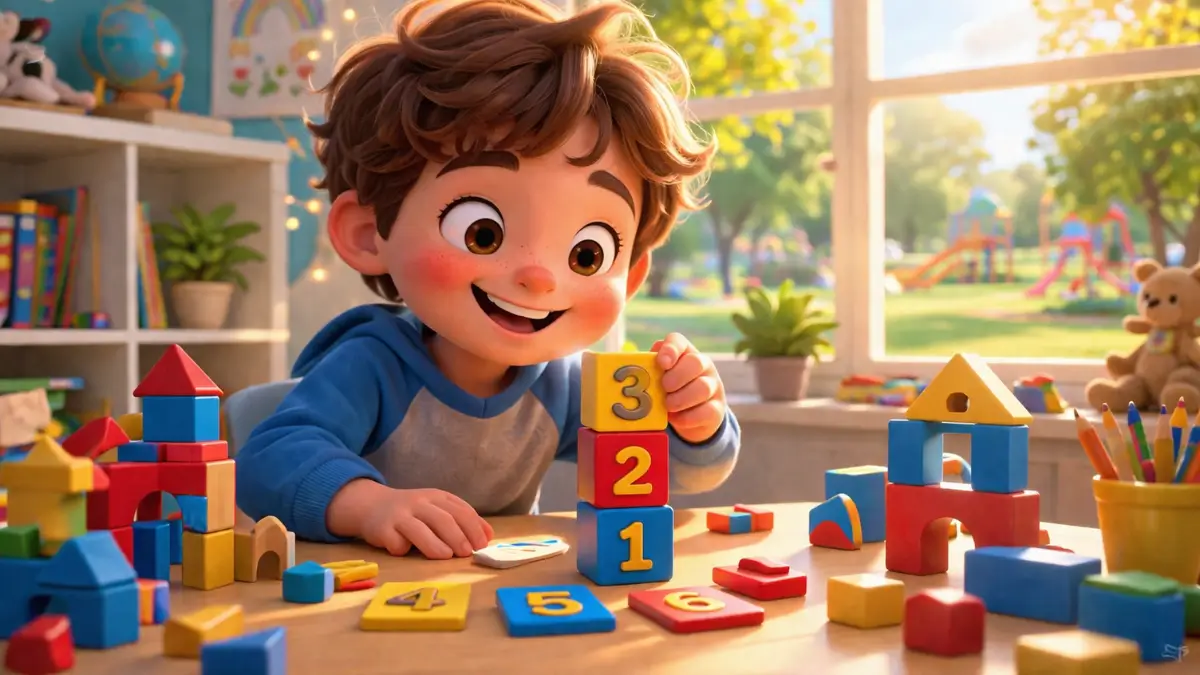
Do you remember the moment your child first counted a row of blocks — "one, two, three" — and looked up at you, beaming? Addition is the natural next step, and it doesn't have to mean tears at the kitchen table or worksheets nobody enjoys. In this guide I'll show you how to move your child from counting on fingers to figuring sums in their head calmly, at their own pace, and in the middle of an ordinary day.
In short: start with the concrete (real objects a child can touch), teach them to count on from the larger number, show them the make-ten strategy — and practise in short, frequent, unhurried moments. Below I break each of these down, flag a few traps that are easy to fall into, and answer the questions parents ask me most.
Before you start: is your child ready?
Addition rests on a single foundation — confident counting. Before "2 + 3" means anything, a child needs to count objects reliably and understand that the last number they say tells them how many there are. This sounds obvious, but it's where most later difficulties begin: a child who can recite "one, two, three, four, five" doesn't necessarily know yet that five means that many — a whole handful.
This awareness of quantity — often called number sense — develops gradually, and it's worth nurturing before you move on to operations. One small sign of it is a child recognising, at a glance, that a die shows three dots without counting them one by one. That ability to see small quantities as a whole (rather than a string of separate marks to count) is valuable, because it lets a child later treat numbers as chunks instead of endless tallies.
The good news is that this foundation isn't built at a desk. It's built in passing: setting the table ("bring four forks"), on a walk ("how many red cars can you see?"), waiting in a queue. If your child counts confidently to ten — better still, to twenty — and understands that a number answers the question "how many?", they're ready for addition. If not, stay a little longer with counting itself. You lose nothing; in fact, you save yourself frustration later.
Concrete before symbols — the most important rule
To an adult, "2 + 3 = 5" is self-evident. To a six-year-old, the numeral 2 is an abstract squiggle until it connects to two real things. So we begin addition with what a child can pick up: blocks, buttons, conkers, favourite figurines. This isn't a "baby" version of maths — it's its proper starting point.
Show it live:
- Put down 2 blocks, and next to them 3 blocks.
- Say: "You had two. We add three. How many now?"
- Let your child count them all together — pointing, out loud, unhurried.
Once that picture settles across a few variations (sweets one day, toy cars the next, steps on the stairs), you'll move naturally to a drawing — two circles and three circles on paper — and only at the very end to the written form 2 + 3 = 5. This path — from object, through picture, to symbol — isn't a personal preference; it's the sequence early-maths education is built on. Give children plenty of chances to work with physical objects first, and move to more abstract tools only after that concrete experience.
The most common mistake here is rushing to the symbols. When a child feels quantities, the symbol follows on its own. When we feed them the symbol before they understand what stands behind it, they learn to reproduce answers from memory — and it falls apart at the first harder problem. If you'd like to see the same principle set out in official school expectations, take a look at our guide to the elementary maths curriculum for grades 1–3.
Three strategies that make the difference
Once your child understands what addition is, it helps to give them a few simple tools. These are what turn slow recounting-from-scratch into quick, confident work.
Strategy 1: Count on from the larger number. Children instinctively count everything in order: for "2 + 5" they start at one and laboriously count on seven items. Show them the shortcut — start at the larger number and count on the smaller one: "Hold five in your head… and count on two: six, seven." Less counting, fewer slips. Along the way your child discovers that 2 + 5 and 5 + 2 give the same total — one of a young mathematician's first "superpowers."
Strategy 2: Make ten. Ten is the most important number in early maths, because our whole number system is built on it. Teach your child which pairs "make ten": 1 and 9, 2 and 8, 3 and 7, 4 and 6, 5 and 5. Once those are second nature, harder problems become easy. 8 + 5 then goes like this: "eight needs two to reach ten — that leaves three — so thirteen." This is exactly how adults add in their heads; we just rarely notice we're doing it.
Strategy 3: Use doubles. For some reason, "twin" pairs — 2 + 2, 3 + 3, 4 + 4 — stick in children's minds especially easily. It's worth using that, because neighbouring facts can be derived from doubles: if 6 + 6 = 12, then 6 + 7 is "one more," so 13. This teaches your child something important — that numbers don't have to be counted from zero every time; they can be worked out from what you already know. Researchers who study early number sense highlight exactly this kind of flexible, derived thinking as a hallmark of children who go on to do well in maths.
Introduce the strategies one at a time and without pressure. One well-mastered shortcut is worth more than five introduced at once and half-remembered.
Number bonds: part, part, whole
There's one more idea that pays off across all of early maths — breaking a number into parts. Instead of only asking "what's 3 + 4?", it's worth turning the question around now and then: "we have seven — which two parts can we split it into?" Seven is three and four, but also five and two, six and one. A child who sees a number as a whole made of parts stops treating addition as gathering one at a time and starts noticing the relationships between numbers.
The simplest way to show it is with fingers or blocks: split seven blocks into two piles several different ways, and each time say together how many are in each pile and how many in total. You can also draw a simple "number house": the whole on top, two parts underneath. It looks innocent, but it does something important — it builds a bridge to subtraction. If seven is three and four, then taking four away leaves three. A child who splits numbers freely steps into subtraction without feeling they're starting over — because they're really using what they already know about addition.
Come back to number bonds briefly but often — a few "number houses" over breakfast do more than one long drill now and then.
Common mistakes worth avoiding
Well-meaning parents sometimes make learning harder without realising it. Here are the traps I see most often:
- Rushing to written sums. Worksheets look like "real learning," but if they arrive before a child understands quantities, they only teach reproduction. Hands first, paper later.
- Correcting within a second. When a child slips, the instinct is to supply the right answer at once. Yet catching the mistake themselves is what builds understanding. Better to ask: "can you show me with the blocks?"
- Timed drills and quizzing. Time pressure usually blocks a young child's thinking rather than speeding it up. Speed arrives on its own, once confidence does.
- Comparing with other children. "Emma in your class already adds to twenty" helps no one. Every child has their own rhythm, and that's completely normal.
- Sessions that run too long. An hour-long "lesson" for a six-year-old is a straight road to discouragement. Short and frequent works better — more on that next.
How to practise without tears
Here's the heart of what most parents ask: how do I do this so my child doesn't come to hate maths? A few rules that genuinely work:
- Short, but frequent. Five minutes a day over breakfast does more than an hour-long session once a week. A young child's attention span is short — and that's the norm, not a problem.
- Weave it into the day. "We have three apples, we'll buy two more — how many in the basket?" is a full-fledged addition exercise. Your child learns, in passing, that maths is for something.
- Praise the method, not just the answer. Instead of "well done!" try "I noticed you counted on from the bigger number — clever!" Your child will remember that thinking is what counts, not just the correct result.
- A mistake is part of learning. When your child slips, treat it as something to check together, not a failure. A calm adult in the face of an error is half the battle.
And most importantly: if you see tiredness or resistance — stop. Maths associated with frustration sets learning back more than a single skipped day could ever delay it.
What about counting on fingers?
Many parents worry that fingers are "cheating." Nothing could be further from the truth — fingers are the first, entirely natural counting tool a child always has to hand. Early on they help a child see what's actually happening in addition: two groups joining into one bigger group. In time, as the strategies become automatic, your child will reach for their fingers less and less on their own.
So don't take the fingers away by force — let them fade at their own pace. Removing that support before a child is ready to work in their head usually produces not faster counting, but stress. We explore this further in a separate article: Counting on fingers — help or hindrance?.
What comes next: from addition to subtraction
Once your child adds confidently within ten, then within twenty, subtraction is the natural next step. It helps to present it not as a brand-new, difficult topic but as the other side of the same coin: if 3 + 2 = 5, then 5 − 2 = 3. Children who understand that link learn subtraction far more easily, because they aren't starting from scratch. And once both operations sit firmly, the next floor up is multiplication — adding equal groups; we show how to introduce it without tears in our guide on how to teach multiplication.
A particularly valuable — and, for many children, the first genuinely demanding — moment is addition that crosses ten, sums like 8 + 5 or 7 + 6. That's precisely where the make-ten strategy earns its keep. If your child is approaching this stage, see our guide to adding within 20 and crossing ten, where we break the skill down into small, calm steps.
When a good game helps
Blocks and everyday moments are the foundation — but there comes a point when a child wants to practise on their own, and a parent doesn't always have five free minutes. A well-designed game then offers two things that are hard to keep up at the table: plenty of repetition at the right difficulty level, and immediate, kind feedback — no marking, no sighs.
In EduBert, addition is the world of the Park. Your child works through levels on which the numbers and problems grow gradually, in exactly the spirit described above: concrete and pictures first, symbols after. The tasks follow the same principles as the rest of this article, so the game doesn't "teach differently" from what you do at home — it simply gives your child space for independent practice. The first level of the Park is free, so you can see whether this format suits your child before deciding on anything more. For more playful, at-home ideas, see our article on addition games to play at home.
A game won't replace counting apples together — but it complements it beautifully, especially on the days when "come and sit with me and do maths" simply isn't going to happen.
Frequently asked questions
At what age should I teach my child addition? There's no single right date — readiness matters, not the birthday. Most children are ready for simple addition around ages 5–6, once they count confidently to ten and understand that a number tells you "how many." One child will grasp it earlier, another later, and both are perfectly normal.
How much time a day should we spend practising? For a five- or six-year-old, 5–10 minutes a day is plenty, ideally in short bursts woven into the day. Consistency matters more than length — five minutes daily beats an hour at the weekend.
Is counting on fingers a bad thing? No. It's a natural stage and a real aid to understanding addition. Your child will grow out of it once they can add in their head — there's no need to hurry it along.
What should I do if my child keeps making mistakes with addition? Go back to the concrete for a moment — blocks or fingers — and check whether the slip comes from counting rather than from addition itself. Slow the pace, use smaller numbers, and praise the attempts. Mistakes are a sign to step back, not a sign that something is wrong with your child.
Where should we begin — within ten, or straight to twenty?
Firmly within ten. Only once addition in that range is secure should you introduce crossing ten (such as 8 + 5). Jumping to bigger numbers too soon usually undermines confidence.
Blocks or an app — which is better? Both, ideally. Blocks and everyday situations build understanding, while an educational game provides repetition and independent practice. Treat the app as a complement to counting together, not a replacement.
Learning to add isn't a race. If you look after a solid foundation — concrete before symbols, a few good strategies, and calm, short practice — the rest follows on its own, and your child will remember maths as something that can be understood, not something to fear. And if you'd like to give them a place to practise addition on their own and with a smile, the first level of the Park in EduBert is free — explore it together and see if it's a fit.
Sources
- National Council of Teachers of Mathematics (NCTM), Principles and Standards for School Mathematics — https://www.nctm.org/standards/
- NCTM & NAEYC, Joint Position Statement: Early Childhood Mathematics: Promoting Good Beginnings — https://www.naeyc.org/resources/position-statements/mathematics
- NRICH, University of Cambridge — early number sense and ten-frame activities — https://nrich.maths.org/early-years
- N. C. Jordan et al., A Number Sense Intervention for Low-Income Kindergartners at Risk for Mathematics Difficulties (peer-reviewed research on counting strategies and base-10 concepts) — https://pmc.ncbi.nlm.nih.gov/articles/PMC3566272/
- J. Boaler, What's Math Got to Do with It? — on number sense and flexible, derived number facts.

Written by the EduBert team
We create educational games that combine play with learning math.
Read also
Counting on Fingers — Bad Habit or Natural Stage?
Should you let your child count on fingers? What research and teaching say, when it's completely normal, and when it's worth gently paying attention.
Addition to 20 (Crossing Ten) — When Is Your Child Ready and How to Teach It
Addition to 20 across the tens threshold: how to spot your child's readiness, the making-ten method, and worked examples (8 + 5, 7 + 6).
Addition Games at Home — 8 Ideas With Nothing to Buy
Simple, proven addition games you can make at home with dice, cards and cups. Zero prep, maximum fun and learning for kids aged 5–7.

Try EduBert together
Create a free account and let your child explore — the first level of every adventure is free.
Create free account →No card required — 4 adventures and the Training Meadow