Meet the Park Characters — Gardener Henry, Squirrel Suzie, Goose Greta, Hedgehog Jeremy and Magpie Stephanie
Every character in EduBert has a personality and a role. Meet the heroes who accompany your child while learning addition in the Park Adventure.
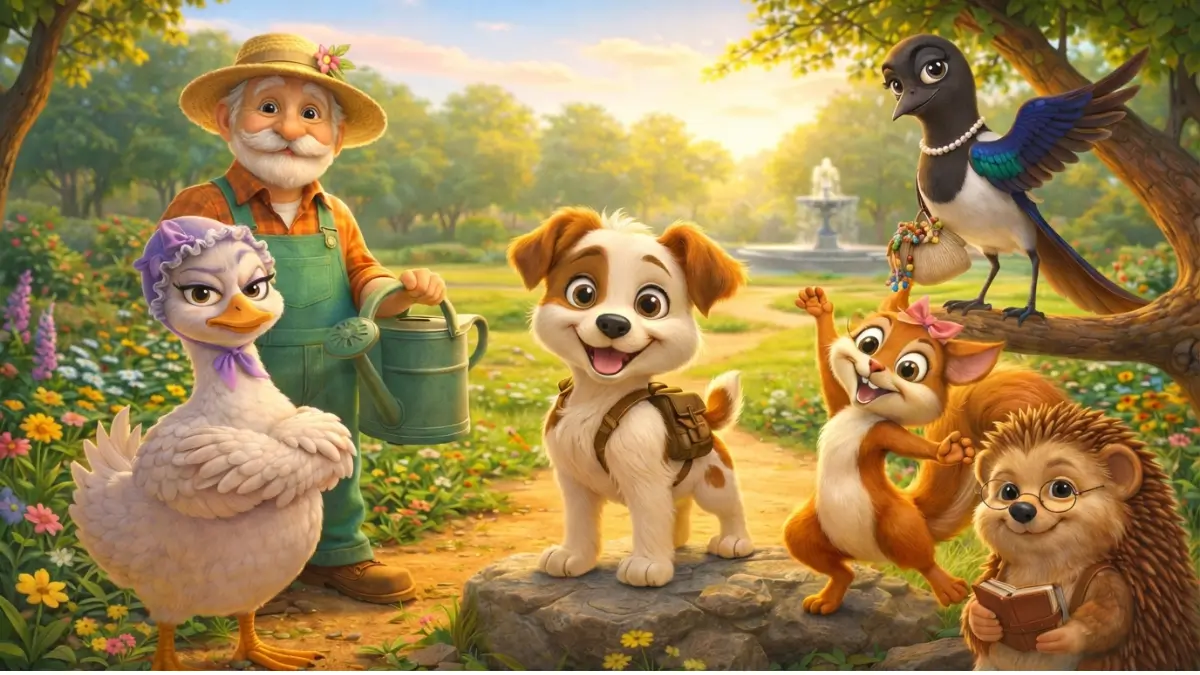
In EduBert, learning math doesn't happen in a vacuum. Your child doesn't solve tasks alone — they're accompanied by a team of characters, each with their own personality, speaking style, and role in the story. This isn't decoration: well-designed characters turn dry counting drills into an adventure a child wants to return to. Here are the heroes of the Park Adventure — and what each one brings to your child's learning.
The World of the Park — Where the Adventure Happens
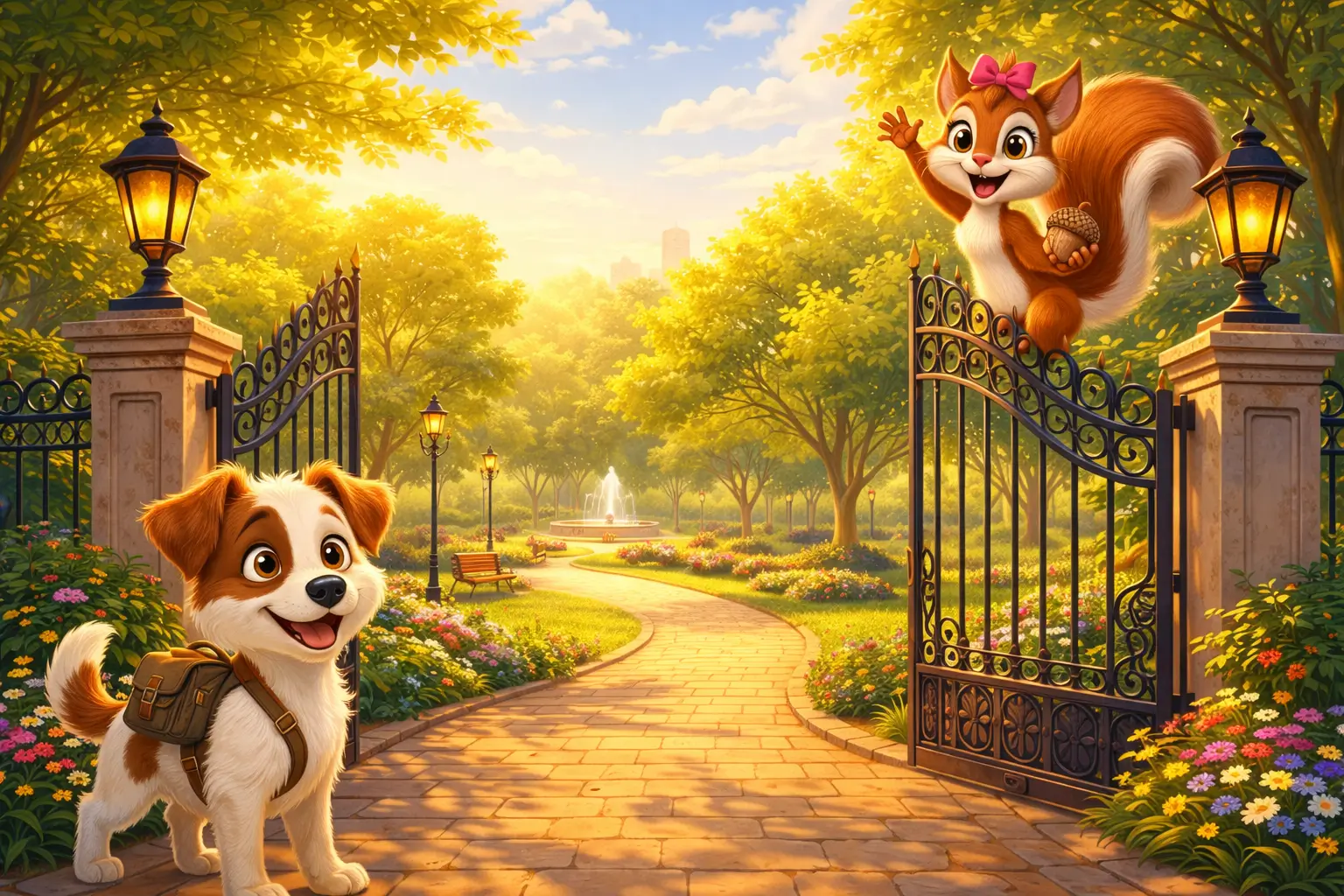
The whole story takes place in the Great City Park, which EduBert has to cross to get home. It's a simple but powerful idea: home is on the other side of the park, and the way there leads through one corner after another — the gate, the fountain, the playground, the cafe, the maze, and the main avenue, all the way to the Great Gate for the finale. Each place is a scene with its own tasks; new friends join in scenes 1, 3, 5, 7 and 9.
Such a world has a big advantage for a child: it's concrete and familiar. A park, swings, a fountain, stones on a path — these are things a child knows from their own backyard, so counting immediately makes sense ("how many flowers by the gate?", not "what's 3+4?"). The adventure unfolds in a place the child can picture, and math weaves into it naturally instead of hanging in the air as an abstract example.
EduBert — A Lost Little Dog with Courage in His Heart
EduBert is a small white dog with brown patches and an adventure backpack. He runs through the gate of the Great City Park — lost, scared, but ready for adventure. He's the hero your child identifies with: he doesn't know everything, but he wants to learn.
At the start, EduBert is unsure of himself but offers to help with counting. By the end of ten scenes he returns home wiser and with friends forever. His journey is a metaphor for learning: from uncertainty to confidence. It's no accident that the hero is a lost puppy rather than a wise teacher. A child roots more readily for someone in a similar spot to their own — a little scared, not yet skilled, but trying. Each of EduBert's small wins feels a bit like the child's own, because they walked the road together. This simple mechanism of identification makes the child want to go on — not to "clear a level," but to help a friend get home. And if you're curious where the idea of a lost little dog came from in the first place, we tell that story in how EduBert came to be.
Mr. Gardener Henry — The Patient Mentor
Henry has been caring for the park for 30 years. He knows every plant by name and every corner by heart. He joins the team from the very first moment — sees a frightened little dog and decides to help without hesitation.
The Gardener speaks calmly and respectfully. At the start he reassures EduBert: "That is a good start. We can work out the rest together." His role is to accompany the puppy on the way home.
His style: tasks connected to nature — counting flowers, seeds, stones on the path. At the gate he gives the first puzzle, at the fountain he teaches repair, at the lanterns — filling in missing numbers.
Quote: "I am Henry. I will look after you. Can you remember what your home looks like?"
Squirrel Suzie — Energy and Enthusiasm
Suzie joins in Scene 3 (Playground) — popping out from behind a swing. She's hyperactive, speaks fast, with CAPS LOCK and exclamation marks. She loses acorns everywhere and is always asking for something.
Her role is crucial: she shifts the atmosphere from "learning" to "fun." When Suzie is on screen, the child smiles. Tasks with Suzie involve carousels, slides, swings — places children know and love. The contrast is deliberate: after focused counting comes a burst of joy, and learning starts to feel like something pleasant rather than a chore.
Suzie shows her affection through action: in the finale she offers to draw a map with an acorn by the playground, so she remembers where she hid it.
Quote: "Hi! I am Suzie! Have you ever chased an acorn? Mine escaped from my bag!"
Goose Greta — Strict but Fair
Greta joins in Scene 5 (Cafe) with a raised brow and crossed wings. She's grumpy, strict, and claims nobody can count. But beneath that tough shell — a heart made of feathers.
Greta cares about order in the café and checks the notes. Difficulty follows the level and task type, not the character speaking. EduBert offers to help before the group rests.
At the Great Gate, Greta holds the plan so it does not blow away. Later she promises to keep crumbs off Suzie’s map. Her care shows in these small actions.
Quote: "Stop. Paws away from the tablecloth. Who is with us today?"
Hedgehog Jeremy — The Quiet Philosopher
Jeremy joins in Scene 7 (Maze). He speaks little but always to the point. He looks at the world with distance and wisdom. His tasks are about logic and patience — the maze requires thinking, not rushing.
Jeremy teaches children that math isn't just about speed. Some problems require stopping, thinking, and counting calmly. His presence slows the pace — intentionally. After Suzie's energy and Greta's intensity, Jeremy brings balance, and shows that taking your time is a skill too.
Quote: "Hmm… I still know the entrance. I have not looked for the exit in years."
Magpie Stephanie — The Park Chronicler
Stephanie appears in Scene 9 (Main Avenue). She collects stories like trinkets — remembers everything that happened in the park. Her role is to summarize the journey: she reminds the child where they came from and how much they've learned.
Stephanie talks a lot and colorfully. Her tasks reference the entire adventure — memories from the fountain, playground, pond. It's the emotional closure of the story just before the grand finale at the Great Gate, where the child sees the whole road travelled at once.
Quote: "Welcome! Stephanie, artist of the park. Are you looking for a splendid ending?"
EduBert's Journey — an Arc from Uncertainty to Confidence
The characters aren't suspended in a void — they add up to a story. Across ten scenes, EduBert makes his way through the park toward home, meeting each character at a different moment: the Gardener right away, Suzie in the third scene, Greta in the fifth, Jeremy in the seventh, Stephanie in the ninth. This rhythm isn't random — the further in, the harder the tasks and the more emotional support around the child.
For a child, this is more than a series of exercises: it's a journey with a beginning, a middle, and an end. EduBert, who was unsure of himself at the start, finds home at the end — and the child who walked with him discovers that they learned to count along the way. This narrative frame means the learning is remembered as an adventure, not as a checklist of tasks.
What also matters is that support grows along with difficulty. The deeper into the park, the more serious the tasks — but also the larger the team around the child. When the demanding Greta appears, the Gardener and Suzie are already there to soften the tension. The child is never left alone with a new difficulty; they always meet it in the company of someone offering encouragement. It's a subtle but important signal: "it'll get harder, but you won't face it alone."
Why Characters Matter
This isn't just about "looking nicer." Children learn more effectively when learning has an emotional context — and emotions weigh especially heavily on a young child. Research on growth mindset shows that children who treat mistakes as part of learning do better than those who see them as failure¹. A character who says "Try again" after a slip builds that mindset far more effectively than a dry "Wrong. Redo."
The point is echoed even more strongly in work on math norms: struggle and mistakes are exactly when the brain grows, and fear of error is one of the biggest brakes on learning². The Park characters carry that message — EduBert himself gets things wrong and keeps going, the Gardener patiently encourages, and no one punishes a mistake. And lasting motivation, research on self-determination reminds us, grows from feeling competent and autonomous rather than from pressure or a dangled prize³ — which is exactly the feeling these characters are designed to create.
In EduBert, each character serves a different emotional function. The Gardener provides safety. Suzie brings joy. Greta creates challenge. Jeremy offers reflection. Stephanie provides closure. Together they create a complete learning-support environment: safe enough that the child isn't afraid to try, and demanding enough that trying feels worth it.
What Unites the Whole Team
Though every character is different, one rule unites them all: no one punishes the child for a mistake. The Gardener encourages, Suzie melts tension with laughter, Greta demands but fairly, Jeremy cools the rush, Stephanie recalls the road travelled — and none of them ever says "you lost." It's a consistent emotional tone across the whole game: a slip is a step in learning, not a defeat.
This variety of temperaments has another purpose. Children differ — one needs warmth and safety, another blossoms at a challenge, another at calm and reflection. A team with a gentle Gardener, a demanding Greta, and a quiet Jeremy reaches different temperaments. Every child finds a character who "speaks their language" — and, along the way, learns that a single crew has room for very different personalities.
How Parents Can Use the Characters
The characters work best when they don't stay locked in the screen. You can carry them into everyday talk about learning. Ask your child: "What would the Gardener say if it didn't work the first time?" — and let them answer "try again" themselves. When a child gets discouraged, remind them that EduBert was unsure of himself at first too. And when a hard task goes well, you can joke that "even Greta would be impressed."
This isn't play for its own sake — such references give the child a language for talking about their own emotions and mistakes. Instead of "I'm stupid," you get "that was hard, but I'll try again, like EduBert." Talking about the characters together also strengthens your bond and turns learning into a shared topic rather than a chore done alone.
It works beyond the tablet, too. The characters can step into ordinary situations: counting stairs "like the Gardener at the lanterns," finding pairs while setting the table, calmly solving a puzzle "at Jeremy's pace." Children love it when a favorite hero "shows up" outside the game — and in the process they carry that calm attitude toward mistakes over to their own real challenges. In the evening you can simply ask: "Which character did you meet today, and what did you do?" — a great start to a conversation about what your child learned.
Characters and the Other Worlds
The Park team is the cast of the addition world. But EduBert grows along with the child — beyond the Park, three more worlds are waiting: the City (subtraction), the Beach (multiplication) and the Forest (division), each with its own mood and its own team. You can meet them all in the post about the four worlds of EduBert. The consistent "team" formula means that moving to a new world isn't learning the game from scratch for a child, just the next chapter of a familiar adventure.
Summary
The heroes of the Park Adventure aren't decoration — they're part of the method. Each of them, from the patient Gardener to the strict Greta, gives the child something different: safety, joy, challenge, reflection, and closure. Together they turn counting into a story where a mistake is natural and trying pays off. Want to meet them in person? The Park Adventure begins with meeting the Gardener — the first level is free.
Frequently Asked Questions
How many characters are in the Park Adventure? The child is accompanied by five friends — Gardener Henry, Squirrel Suzie, Goose Greta, Hedgehog Jeremy, and Magpie Stephanie — while the main hero the child identifies with is the little dog EduBert himself.
Are the characters just decoration, or do they really help learning? They help. Each serves a different emotional function (safety, joy, challenge, reflection, closure), and emotional context genuinely supports how young children learn to count.
When does each character appear? The Gardener is there from the start, Suzie joins in scene 3, Greta in 5, Jeremy in 7, and Stephanie in 9. The adventure runs ten scenes and ends at the Great Gate.
Won't Greta, who's strict, discourage my child? No — Greta is demanding but fair, and her sparing praise means more precisely because it has to be earned. Beneath the tough shell is a warmth that shows in the finale.
What do the different characters' tasks teach? The Gardener gives nature tasks (counting flowers, seeds, stones), Suzie brings the playground, Greta checks the café’s notes, and Jeremy trains logic and patience in the maze.
Can I use the characters outside the app? Yes, and it's worth it. References in conversation ("what would the Gardener say?") give the child a language for mistakes and emotions and turn learning into a shared topic.
Do the other EduBert worlds have different characters? The Park team is the cast of the addition world; the other worlds — City, Beach and Forest — have their own teams and their own mood. You'll find more in the post about the four worlds of EduBert.
A well-written character can do more for learning than many a worksheet — because it gives a child a reason to want to. If you'd like to see how the Park heroes support learning addition in practice, The Park Adventure is waiting — the first level is free.
Sources
- Dweck, C. S., "Mindset: The New Psychology of Success" — growth mindset; treating mistakes as part of learning rather than failure, and the value of encouragement after a slip.
- Boaler, J., "Mistakes Grow Your Brain" (youcubed, Stanford): youcubed.org — struggle and mistakes as moments of learning; reducing fear of error.
- Deci, E. L., & Ryan, R. M., Self-Determination Theory: selfdeterminationtheory.org — lasting motivation grows from competence and autonomy, not from pressure or punishment.

Written by the EduBert team
We create educational games that combine play with learning math.
Read also
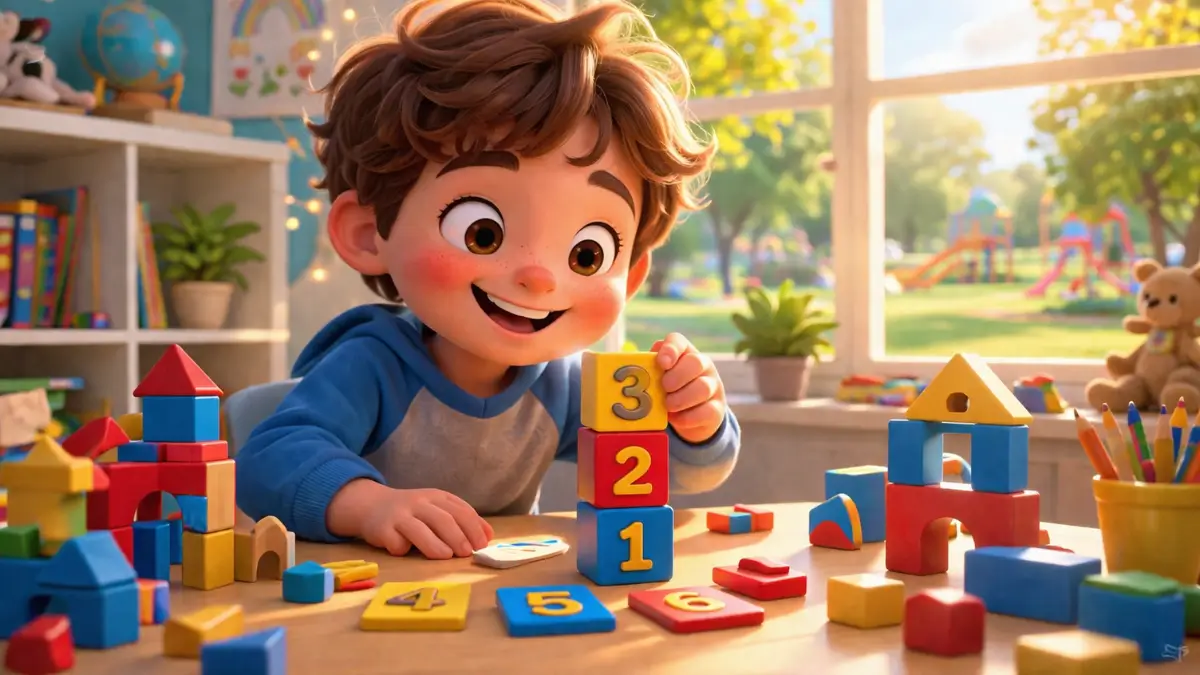
How to Teach Your Child Addition — Calmly and Without Tears
Teach your child addition step by step: from blocks to mental math, three strategies that make the difference, and how to practice without pressure or tears.

The Four Worlds of EduBert — Addition, Subtraction, Multiplication and Division in One Game
Meet EduBert's four worlds: addition, subtraction, multiplication and division in one game. All available now, first level of each free to play.

Educational Games for Kids — Do They Really Work? What Research Says
What research says about educational games: when they help kids learn math, how to spot a good one, and how much screen time is too much.

Try EduBert together
Create a free account and let your child explore — the first level of every adventure is free.
Create free account →No card required — 4 adventures and the Training Meadow