How to Teach Multiplication to Kids — from Equal Groups to Times Tables Without Tears
How to teach multiplication step by step: equal groups, skip counting and times tables without cramming. A concrete plan for parents of kids aged 5–7.
"Times tables" — for many of us the phrase smells of flashcard drills, pop quizzes and a knot in the stomach. It doesn't have to be that way. Multiplication is taught differently now: first a child sees equal groups — three plates with four strawberries each — and only then meets the notation 3 × 4 and the times tables. The order is simple: concrete, picture, symbol. In this guide I break it into steps you can do at home, at the table and on a walk — no pressure, no tears.
Before you start: is your child ready?
Multiplication stands on addition — literally. Before a child can understand that "three groups of four" makes twelve, they need confident adding and a feel for "the same amount in each". Two readiness signs you can check in minutes:
- Confident addition within 20. Your child works out 4 + 4 + 4 without guessing or giving up. If that still wobbles, take a step back — we have a full guide on how to teach addition.
- Understanding "equally". Ask: "share these blocks into three piles, the same number in each". If your child understands the task (even if the execution is shaky), the foundation is there.
Formally, multiplication enters the classroom around second grade, and most curricula expect fluent times tables by the end of third grade. With a five- or six-year-old you're not drilling tables — you're building the concept: groups, rhythms, counting in jumps. That's the best possible investment, even if the × sign only shows up a year from now.
What multiplication really is — groups of "the same amount"
Here's the heart of it, and it decides everything that follows: multiplication is not "faster adding of two piles". It's counting groups that are equal in size. In 3 × 4, each number plays a different role: the three says how many groups, the four says how many in each. Three plates of four strawberries. Five dogs times four paws. That's a completely different structure from addition, where you simply join two amounts into one.
Why does this matter so much? Because a child who thinks of multiplication as "groups of the same amount" can handle any new problem — they just picture it. A child who only memorized "three times four is twelve" has nothing to hold on to the first time they're unsure. Every exercise below circles one image: a groups of b things. If you remember one thing from this article, make it that.
Concrete before symbols: from strawberry plates to 3 × 4
Children aged 5–7 learn in a fixed order: concrete → picture → symbol. In practice:
- Build groups from real things. Three plates, four strawberries on each. The question is always the same: "How many plates? How many on each? How many altogether?" Your child counts them all — and that's fine; at this stage it isn't cheating, it's learning.
- Change the props, keep the structure. Cups and straws, boxes and toy cars, pockets and pebbles. "The same amount in each" should become an old friend, met in dozens of costumes.
- Move to pictures. Draw three circles with four dots in each. Same world, now on paper — your child stops needing objects in hand.
- Add the language of maths. Before any symbol, say: "three groups of four". Your child repeats it, describes their own drawings, invents their own examples.
- Show the notation last. "Three groups of four — mathematicians write it like this: 3 × 4." The symbol arrives as shorthand for something already understood, not as a spell to memorize.
One session covers one or two steps, never all of them. Rushing to the symbol is the single most common reason multiplication "won't stick".
Skip counting: by 2s, 5s and 10s
Between addition and the times tables there's a bridge that's easy to overlook: skip counting. Two, four, six, eight... Five, ten, fifteen... These are future rows of the times tables — dressed up as a rhythm children genuinely enjoy.
You can skip count anywhere: on the stairs (every other step — counting by twos), with a jump rope, while clapping, counting the whole family's fingers ("five, ten, fifteen, twenty!") or the chair legs in the kitchen. A child who counts fluently by 2s, 5s and 10s is carrying nearly half the times tables in their pocket before they ever hear the word "multiplication". Counting backwards in skips is worth adding too — it quietly lays the groundwork for division.
The rectangle that does magic: 3 × 4 = 4 × 3
Once groups feel solid, show your child multiplication's second picture: a rectangle of blocks. Lay out 3 rows of 4 tiles (blocks, coins, sugar cubes — anything). Count them: twelve. Now turn the whole rectangle a quarter turn. Suddenly it's 4 rows of 3 — and the count is... still twelve.
This is one of maths' first "wow" moments: 3 × 4 and 4 × 3 are the same rectangle, just rotated. For your child it's a building game; for their future times tables it's half the work gone, because whoever knows 3 × 4 automatically knows 4 × 3. You don't need to say "commutativity" — it's enough that your child turns the rectangle with their own hands and sees it.
Times tables without tears — the order matters
The full times tables are a two-year project at school — most curricula expect fluency by the end of grade 3; we map the whole journey in our guide to the elementary math curriculum for grades 1–3. At home, the biggest win is a smart order of facts, because the tables aren't uniformly hard:
- Start: ×1, ×2, ×5, ×10. Ones are obvious, twos are doubling ("four and four again"), fives and tens your child already knows from skip counting. After this stage they know more than half the tables — and they know it, which does wonders for confidence.
- Then: ×3, ×4. Threes by counting on from the familiar twos; fours as "double, then double again" (4 × 6 is double 2 × 6).
- Last: ×6, ×7, ×8, ×9. Sounds scary, but thanks to the rotated rectangle most of these facts are already known from the other side (7 × 2 = 2 × 7). Only a handful of genuinely new facts remain, and the nines have a lovely trick: 9 × 6 is 10 × 6 minus one six.
And the golden rule: short but daily. Five minutes of rhythmic practice beats an hour of Sunday drilling — we unpack this in how much daily math practice a child needs. No stopwatch quizzes, either: time pressure can block a child who actually knows the fact.
Common mistakes worth avoiding
- Starting with the symbol. A worksheet of
3 × 4 = ?before the plates-and-strawberries stage teaches reciting, not understanding. One harder number and it all collapses. - Drilling tables with no model. A recited "six times seven is forty-two" with no picture of groups behind it is knowledge as fragile as a biscuit. Model first, fluency second.
- "Multiplication is just fast adding" — full stop. Yes, 3 × 4 can be worked out as 4 + 4 + 4, and at first it will be. But stopping there loses the group structure — the very thing that later powers division, fractions and percentages.
- Comparing and racing. "Emma already knows all her tables" doesn't speed anything up — it adds fear. The only useful benchmark is your own child a week ago.
Multiplication in everyday life
The best exercises don't look like exercises. At the table: "Four people, two pancakes each — how many do we fry?" At the shop: "Three packs of six yoghurts — how many yoghurts in the trolley?" On a walk: "How many paws on those three dogs?" At home: "Two hands, five fingers each — how many fingers in our whole family?"
The secret is asking the same three questions every time: how many groups, how many in each, how many altogether. Your child won't even notice they're practising — and you don't need worksheets or a free evening.
Games that teach multiplication (zero worksheets)
When you do want to sit down and practise "properly", you still don't need an exercise book. A few games that do exactly the same job:
- Two dice. Roll two dice: the first says how many groups, the second how many in each. Your child builds the groups from blocks and counts the total. The randomness keeps the tension up better than many board games, and every turn is a fresh "a groups of b" in disguise.
- Monster drawing. "Draw four monsters, each with three eyes. How many eyes are staring at you?" Children adore this one — and they're constructing equal groups themselves, first in pencil, later in their heads.
- Playing shop. Stickers at 2 each, toy cars at 5. Your child buys three and works out the bill. Money practice comes free with it — two birds, one stone.
- Dominoes and cards. "Three domino tiles, five pips on each — how many pips altogether?" Ready-made equal groups live in every games box.
The common thread: the child sees the groups every single time, and the questions ("how many groups? how many in each?") are asked by the game, not by an examiner.
Where to start — a plan for the first week
- Days 1–2: groups from real objects. Plates and fruit, cups and blocks. Questions: how many groups, how many in each, how many altogether. Ten minutes a day.
- Day 3: skip counting by 2s and 5s — on the stairs, while clapping. Attach it to something you already do daily.
- Day 4: drawn groups — circles and dots. Your child invents an example and quizzes you (swapping roles works wonders).
- Day 5: the block rectangle, rotating it, discovering "it's the same number!".
- Day 6: language: "three groups of four" — and only if your child describes groups comfortably in words, show the notation 3 × 4.
- Day 7: a review in whatever game form your child picks. End on a high note.
If any day doesn't click — stay on it longer. The plan is a map, not a timetable.
How to practise multiplication with EduBert
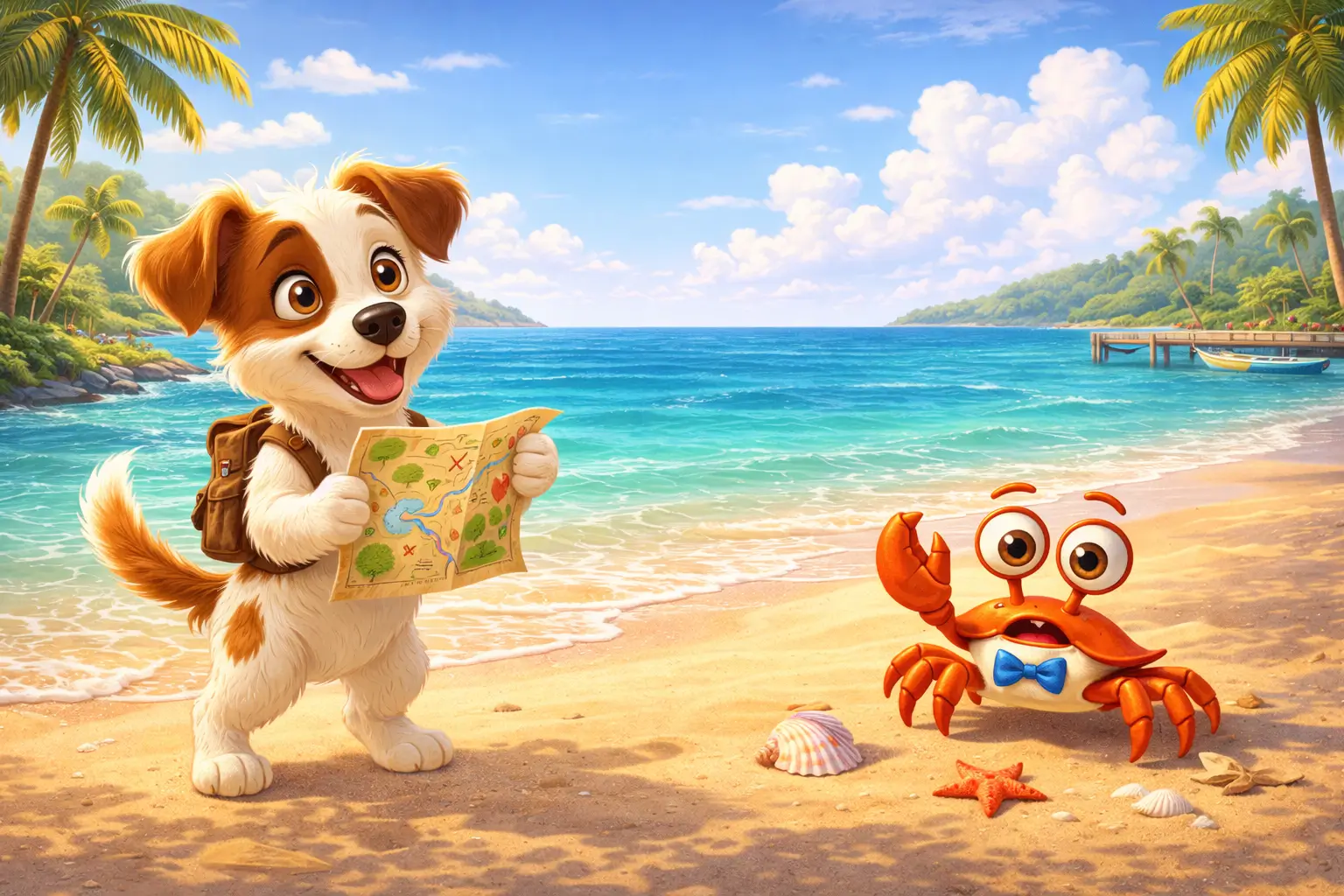
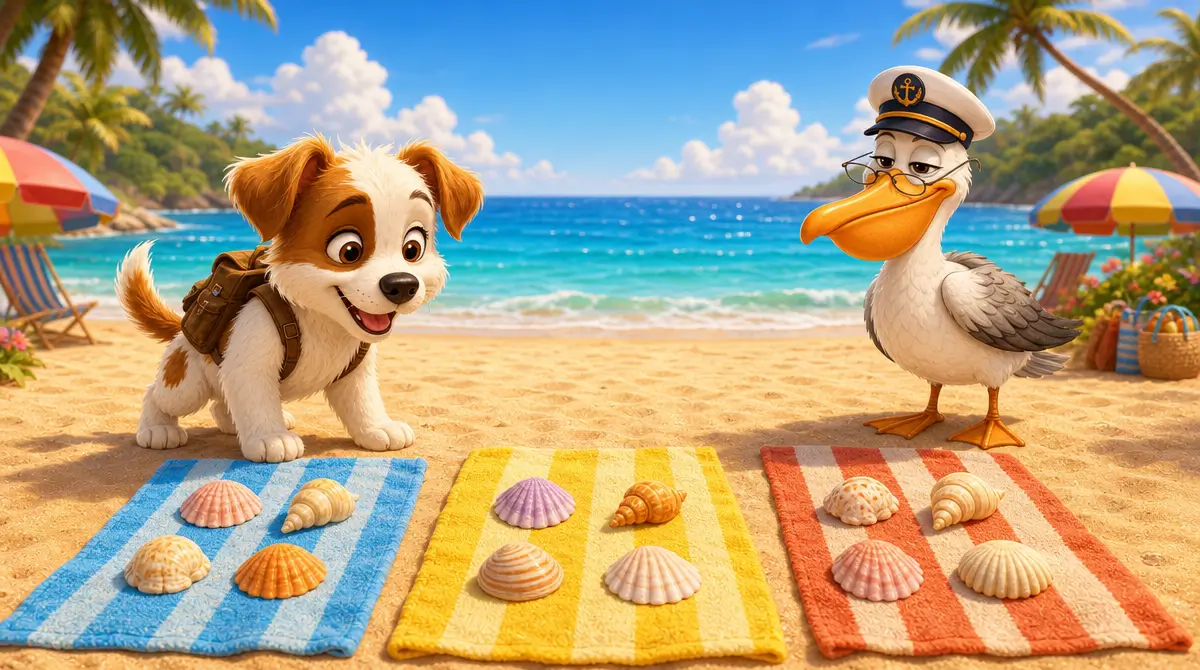
In EduBert, multiplication is the world of the Beach — and it works exactly by the principles in this article. Your child sees equal groups: three towels with four shells each, five parasols with two loungers under each — and counts them before any symbol appears. Difficulty climbs level by level, with Pete the Pelican, Clem the Crab, Felicity the Seal, Basia the Turtle and Maya the Seagull along for the trip. A mistake never ends the adventure — it's a chance for another go, not a punishment.
For rhythmic times-tables practice there's also the Training Meadow, where your child drills a chosen operation with no storyline — in short bursts, exactly the way the brain likes it. The first level of the Beach (and of every operation on the Meadow) is free, so you can quietly check whether the format suits your child.
Frequently asked questions
When should we start multiplication?
Conceptually — even at five: equal groups, skip counting, pair games. Formal times tables belong to grades 2–3. If your child adds confidently and understands "equally", you can start with groups; there's no race to the × sign.
Should kids memorize the times tables? Ultimately, yes — fluent facts free the mind for harder things. But memory should come after understanding, not instead of it. First groups and rectangles, then short regular practice. Drilling without a model produces knowledge that crumbles at the first unusual question.
Which tables should we learn first? ×1, ×2, ×5 and ×10 — they're the easiest and instantly give your child more than half the tables. Then ×3 and ×4, and last ×6–×9, where most facts are already known "from the other side" thanks to the rotated rectangle.
What if my child adds instead of multiplying? That's not a mistake — it's a stage. Multiplication genuinely grows out of adding equal groups. Let them add, but keep the language sharp: "how many groups? how many in each?". In time they'll notice that remembering the result beats adding from scratch.
My child knows the answers by heart but can't do word problems — why? That's the classic sign the tables went in without a model: your child knows the call-and-response, but doesn't see the groups behind the numbers. Go back to drawing the situations ("three packs of five stickers — draw it") — once a child can turn a story into a picture of groups, the notation follows on its own.
How much practice per day? For a 5–7-year-old: 10–15 minutes, daily or nearly so, always stopping before boredom sets in. Consistency beats intensity — a short daily portion builds more than a weekend marathon.
Multiplication isn't a race — it's the second floor of the house you started building with addition. Groups, skips, the rectangle, and only then the tables: in that order your child won't just remember the answers, they'll know where they come from. And once multiplication settles in, the natural next step opens up — division, which is multiplication seen from the other side. Want to give your child a place to practise equal groups on their own, with a smile? The first level of the Beach is free — explore it together and see if it's a fit.
Sources
- NRICH (University of Cambridge), "Arrays, Multiplication and Division" — on the array (rectangle) model in teaching multiplication and commutativity: https://nrich.maths.org/articles/arrays-multiplication-and-division
- NRICH (University of Cambridge), "Multiplication and Division: Age 5–7" — activities and progression for early multiplicative thinking: https://nrich.maths.org/multiplication-and-division-age-5-7
- Jo Boaler et al., "Fluency Without Fear" (youcubed, Stanford University) — research evidence on learning math facts through number sense rather than timed drill: https://www.youcubed.org/evidence/fluency-without-fear/
- Stanford Graduate School of Education, "Research shows the best ways to learn math" — summary of research on fluency, timed testing and math anxiety: https://ed.stanford.edu/news/learning-math-without-fear

Written by the EduBert team
We create educational games that combine play with learning math.
Read also

How to Teach Division to Kids — from Fair Sharing to the ÷ Sign
How to teach division without tears: from sharing equally, through the two meanings of division, to the ÷ sign. A practical plan for parents of kids 5–7.
How to Teach Your Child Addition — Calmly and Without Tears
Teach your child addition step by step: from blocks to mental math, three strategies that make the difference, and how to practice without pressure or tears.

Elementary Math Curriculum (Grades 1–3) — What Your Child Needs to Know
What your child must know in math after grades 1, 2 and 3 under the Common Core — a clear year-by-year overview and how to support them at home.

Try EduBert together
Create a free account and let your child explore — the first level of every adventure is free.
Create free account →No card required — 4 adventures and the Training Meadow