How Much Time Should Your Child Spend on Math Each Day — A Calm Answer for Parents
How many minutes of daily math practice does a 5–7 year old need? Age-based recommendations and why consistency beats intensity.
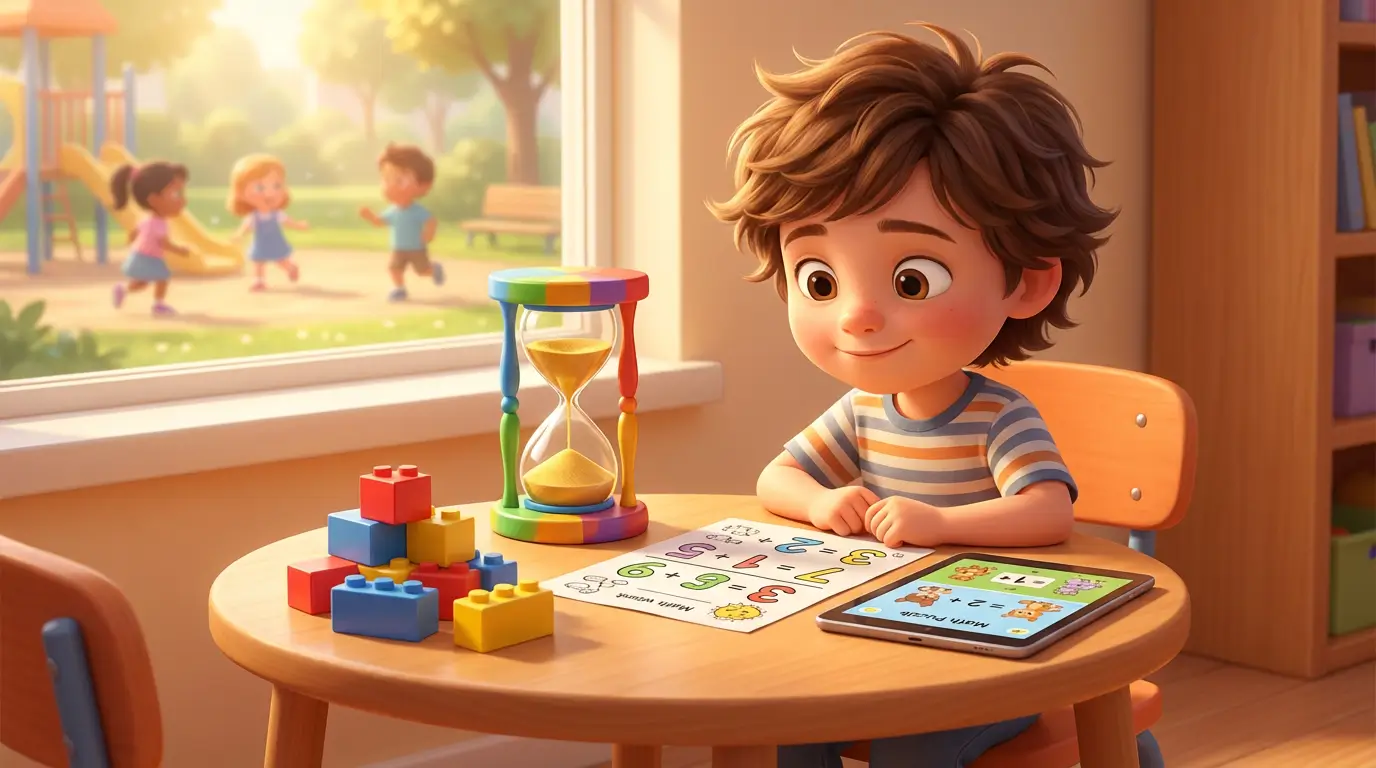
"How many minutes a day should I practise with them for it to actually count?" — it's the question I hear from parents most often, usually with a note of worry that they're doing too little. Here's the good news: the answer is shorter than you expect, and far less stressful than your conscience suggests.
In short: a 5–6 year old needs about 10–15 minutes a day, a 7–8 year old 15–20 minutes, and an older, 9–10 year old child 20–30 minutes. And that really is all — provided those few minutes happen every day and in the form of play, rather than once a week as an hour-long "lesson at the table." Below I explain where those ranges come from, what a good short session looks like step by step, and how to tell when today calls for stopping early.
How many minutes, exactly — by age
Treat these numbers as a starting point, not a quota to enforce:
- Ages 5–6: 10–15 minutes a day. At this stage what matters most is contact with the concrete — counting real objects, simple games, talking about numbers as the day goes by.
- Ages 7–8: 15–20 minutes a day. The child is consolidating addition and subtraction and moving into multiplication — a short, regular dose of practice makes an enormous difference here.
- Ages 9–10: 20–30 minutes a day. There's more to consolidate (times tables, division), so the session can run a little longer — but still counted in minutes, not hours.
These ranges aren't arbitrary: they roughly match how long a child of each age can focus meaningfully. A session longer than a child's attention doesn't add learning — it adds tiredness and reluctance.
One more thing: don't apply an older child's range to a younger one. A five-year-old made to sit for twenty minutes won't learn twice as much as in ten — they'll just have time to get discouraged, and to file maths away as something that "wears you out." Start at the lower end for the age, and extend only when the child reaches for more on their own.
Why so little? Because consistency beats intensity
This is the single most important sentence in the whole article: ten minutes every day does more than an hour once a week. And that isn't a comforting slogan for busy parents — it's one of the best-supported findings in the science of learning, known as distributed (spaced) practice.
It comes down to how memory works. For information to move from short-term into lasting memory, the brain needs time to consolidate — and that happens between sessions, in the gaps, including during sleep, not inside one long sitting. When we return to material after a break and have to recall it, the memory trace strengthens. That's why seven short encounters with maths across a week build sturdier knowledge than two long ones. Short but frequent isn't a compromise — it's simply the more effective method.
Picture two children who spend the same total time on maths in a week. The first practises once, on Saturday, for an hour. The second does ten minutes from Monday to Friday. After a month, the second child almost always counts more confidently, even though the "hours" add up the same. The difference isn't greater effort — it's that their brain got regular, short reminders and refreshed the memory trace each time. That's distributed practice in action, and genuinely good news for any stretched parent.
There's a second, quieter benefit too: a short daily dose never has time to tire or discourage a child. And a child's attitude to maths — whether they associate it with calm or with stress — will shape their learning more than a dozen extra minutes of drill ever could.
What a good session looks like — step by step
A good session doesn't have to resemble a lesson. Here's a simple recipe that works in most homes:
- Open with something easy. The first minute is a warm-up — a problem the child is sure to solve. The point is to get them into "I've got this" mode rather than "hard again."
- Stick to one thread. In a short session you do one thing (say, making ten), not five at once. One topic practised well beats five barely touched.
- Turn practice into conversation. Instead of quizzing, ask "how did you work that out?" A child explaining their method locks it in better than the correct answer alone.
- Stop before they tire of it. The best moment to finish is while the child still wants more. That's what gets them sitting down tomorrow without a fight.
And how do you fill those minutes? Three tested options, depending on age:
The "blocks" version (ages 5–6): 5 minutes of play with blocks or buttons (two piles, count together), 5 minutes of a dice game, 5 minutes of questions on a walk ("how many red cars can you see?"). No worksheets — just the concrete and conversation.
The "app" version (ages 6–8): 10–15 minutes with a well-designed educational app — for example, a few activities in EduBert, at your child’s pace. The difficulty progression, immediate and kind feedback, and story are all built in, so the child practises independently while you catch your breath.
The "mixed" version (ages 7–10): 5 minutes of quick review (times tables, fast addition) plus 10 minutes of new material — workbook or app tasks. The review at the start refreshes what's already there; the new material adds a brick.
When during the day?
Many children are at their most receptive in the morning and early afternoon, and by evening, after a full day, their attention noticeably fades. So if you have a choice, aim for the first half of the day or the slot right after an afternoon snack rather than just before bed.
But don't turn this into another source of pressure. The best time is the one that genuinely fits your day. A regular session at 5 PM is worth far more than a theoretically ideal one at 9 AM that never actually happens. The key is steadiness: once a child knows that "after snack we do ten minutes of maths," they stop negotiating it and stop treating it as a punishment — it becomes an ordinary part of the day, like brushing teeth.
If your week is uneven, it helps to have one steady "anchor" for schooldays and another for the weekend — what matters is that each is predictable. A child who knows when maths arrives doesn't spend energy arguing whether it's happening at all.
Signs the session is too long
A child will tell you when they've had enough — just not in words. Watch for these: they start fidgeting in their chair, answers turn increasingly random (guessing instead of counting), a scowl or flash of anger appears, or the classic "I don't want to anymore."
When you see that — stop, with no negotiation and no "just one more problem." Pushing through to finish the plan won't add learning; it will take away the appetite for tomorrow. Ending on a good note — "you were brilliant with those tens today!" — matters more than ticking off everything you planned. Maths tied to frustration sets learning back more than one shorter day could ever delay it.
Signs the session is too short
Sometimes it's the reverse: the child asks for more, solves everything quickly and effortlessly, gets bored after three minutes. That's an important signal — but usually about difficulty, not time. Before you extend the session, try raising the bar: bigger numbers, a harder type of task, fewer hints.
EduBert has predefined difficulty levels. Choose a level suited to your child and return to an easier one when they need practice; the game does not automatically assess the limit of their ability. If you'd like to understand where to begin and how to build addition up at home, see the guide How to Teach Your Child Addition — and once addition sits firmly, the natural way to raise the bar is subtraction, which we break down step by step in How to Teach Your Child Subtraction.
What about homework?
Maths homework doesn't count toward these few minutes. They're two different things: homework is a school obligation, while your short practice is extra, voluntary support in the form of play.
So don't stack one on the other. If a child has twenty minutes of school maths today — skip the extra session. Their head has already done its work, and piling on another dose usually breeds resentment toward the very subject you care about most. Consistency is measured in weeks, not single days — one "off" evening spoils nothing.
Common mistakes worth avoiding
Even parents who try hard sometimes work against themselves without realising. Here are the traps that show up most often with "practice at home":
- Weekend catch-up sessions. "There was no time this week, so today we'll do an hour" is the exact opposite of how memory works. Ten minutes on Sunday beats an hour once a week.
- Practising against the clock. A stopwatch usually blocks a young child's thinking rather than speeding it up. Speed arrives on its own, once confidence does.
- Using practice as punishment. "You didn't tidy up — now do extra sums." Maths used as a penalty is remembered as a penalty.
- Comparing with other children. "Emma already counts to a hundred" doesn't motivate — it intimidates. Every child has their own rhythm, and that's normal.
- Extending when it's going well. It's tempting to "keep going while they're into it." Better to finish on a high and leave an appetite for tomorrow.
When a good game helps
Ten daily minutes sounds simple until it meets a real afternoon — dinner, a younger sibling, and your own tiredness. That's exactly where a well-designed game can be a lifeline: it gives a child plenty of repetition at the right difficulty level and an immediate, kind response to every answer — with no marking and without your constant presence.
EduBert is built precisely for these short sessions: a level has 10 activities; its duration depends on reading, calculation and retries. A child practises addition in the Park, subtraction in the City, multiplication on the Beach and division in the Forest — and the difficulty rises gradually, in the spirit of everything above: visual models and written expressions appear in the order of the story. The first level of every world is free, so you can quietly see whether this format suits your child. A game won't replace counting apples together — but it fills the days when "let's sit down and do maths" simply isn't going to happen. And if you worry about time in front of a screen, we lay it out calmly in Screen Time and Learning — a Healthy Balance.
How to keep it consistent
The whole secret of this method lives in one word — consistency — so it's worth making it easy on yourself. Three things that genuinely work:
- A fixed time, attached to a habit. "After breakfast — ten minutes of maths." When the session hangs off something you already do daily, the daily debate over "do we have to today" disappears.
- A visual tracker. A calendar on the fridge and a sticker for each practice day. Children love watching their streak grow — and visible progress fuels the next day on its own.
- A reward for the streak, not the score. "Seven days in a row? You pick the weekend film." You reward what you care about — consistency — not the number of flawless answers.
And when the streak breaks — because someone gets ill, you travel, or it simply slips your mind — just come back the next day, guilt-free. Consistency isn't a spotless run; it's returning to the rhythm after each break. A parent who doesn't make a drama of one missed day teaches a child the healthiest possible attitude to learning.
Frequently asked questions
Is 10–15 minutes a day really enough? For a 5–7 year old — yes, as long as it's daily and pressure-free. A short, regular dose builds sturdier knowledge than rare long sessions. If your child wants more and is enjoying it, don't cut it off; this is the safe lower bound, not a ceiling.
What if we only manage a few days a week? A few short sessions beat none. Aim for daily, but don't make a drama of a missed day — consistency is judged over weeks. Three or four short sessions still beat one long "catch-up" by a wide margin.
My child doesn't want to practise — what do I do? First shorten and simplify — resistance often comes from a session that's too long or too hard. Swap tasks for a game or an everyday moment ("shall we count the plates for the table?"). And check the time of day: a tired child in the evening will protest whatever the topic. And if the resistance comes with difficulties that don't fade for months despite short, well-chosen sessions, read up on how to recognize dyscalculia — it's usually not the cause, but it's worth knowing the difference.
Does app time count the same as counting with a parent? Yes, if the app is well-designed and truly teaches — with difficulty progression and meaningful feedback, not just holding attention. The best setup is both: counting together builds understanding, while the app provides independent repetition on the days you don't have five free minutes.
What decides whether to choose 10 or 20 minutes? Mostly the child's age and attention. Start at the lower end for their age, watch for signs of tiredness or boredom, and adjust. Regular ten minutes beats an ambitious twenty that quickly turns into a daily battle.
Learning maths really isn't a race, and you're doing more than you think. A calm quarter of an hour a day, playful and pressure-free, will build both skills and something more valuable — the belief that maths is something a child can understand. And if you'd like to give them a place to practise on their own and with a smile, the first level in EduBert is free — explore it together and see if it's a fit.
Sources
- Dunlosky, J., Rawson, K. A., Marsh, E. J., Nathan, M. J., & Willingham, D. T. (2013), "Improving Students' Learning With Effective Learning Techniques," Psychological Science in the Public Interest — https://journals.sagepub.com/doi/abs/10.1177/1529100612453266 — distributed (spaced) practice is rated among the highest-utility learning techniques.
- NAEYC & NCTM, Joint Position Statement, "Early Childhood Mathematics: Promoting Good Beginnings" — https://www.naeyc.org/resources/position-statements/mathematics — on regular, engaging, developmentally appropriate mathematics experiences for young children.
- NAEYC, "The Beauty of Early Childhood Mathematics: Playful Math = Engaged Learning" — https://www.naeyc.org/resources/pubs/yc/jul2017/playful-math-early-learning — the case for short, playful maths in the early years.
- National Council of Teachers of Mathematics (NCTM), "Procedural Fluency in Mathematics" (position statement) — https://www.nctm.org/Standards-and-Positions/Position-Statements/Procedural-Fluency-in-Mathematics/ — fluency is built through reasoning and practice, not rote drill.

Written by the EduBert team
We create educational games that combine play with learning math.
Read also
Dyscalculia — How to Recognize and Support Your Child
What dyscalculia is, its signs, and what a parent can do. A calm guide — no panic, with concrete steps and where to find real help.
Screen Time and Learning — How to Find a Healthy Balance
How much screen time is reasonable for a 5–7-year-old? How to tell valuable screen use from empty scrolling, and build a healthy balance.

Elementary Math Curriculum, Grades 1–3: A Common Core Guide
Explore the elementary math curriculum for grades 1–3 through Common Core, with clear expectations and practical ways to help at home.

Try EduBert together
Create a free account and let your child explore — the first level of every adventure is free.
Create free account →No card required — 4 adventures and the Training Meadow