Dyscalculia — How to Recognize and Support Your Child
What dyscalculia is, its signs, and what a parent can do. A calm guide — no panic, with concrete steps and where to find real help.
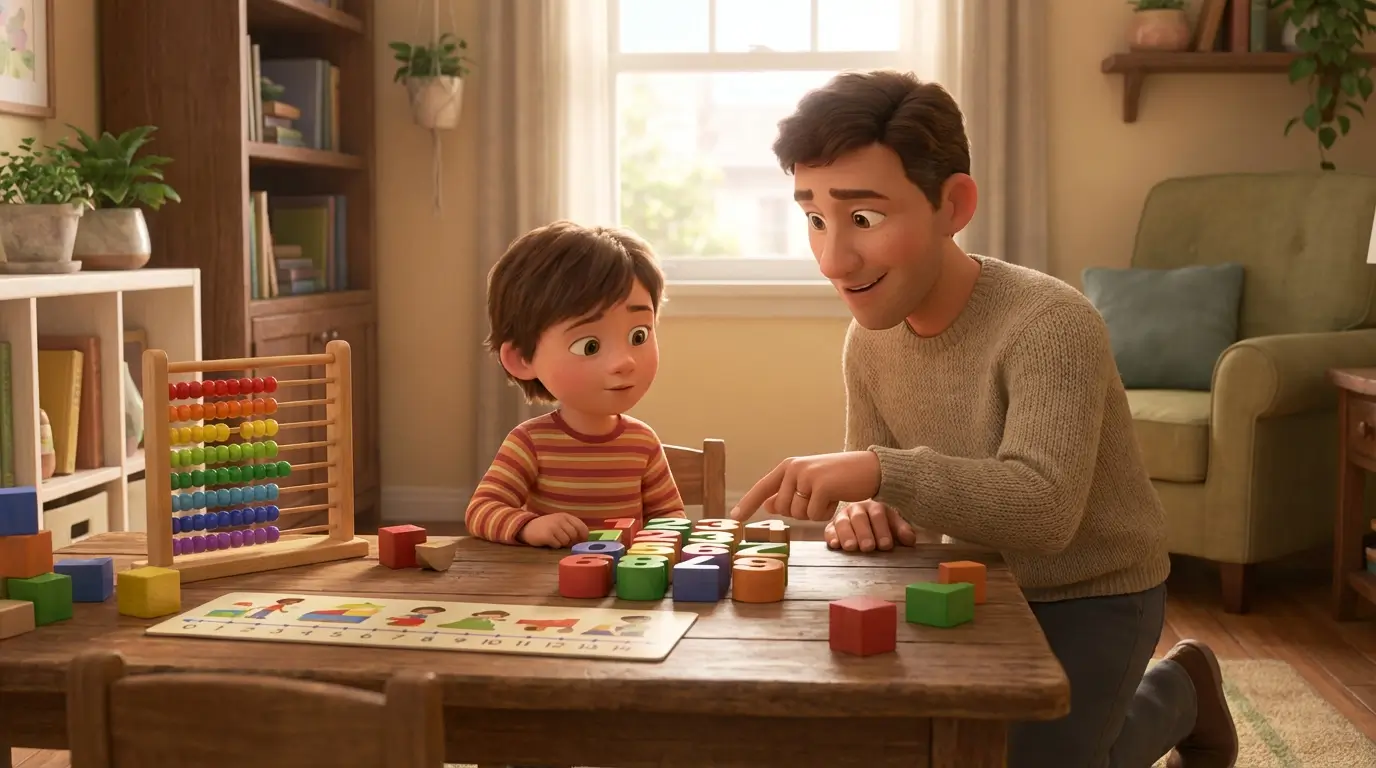
Your child struggles with math. They mix up numbers, can't remember simple sums, count on fingers far longer than their peers. Is it dyscalculia? Or do they simply need more time? This article will help you tell the difference — calmly, without scaremongering, with concrete steps and a clear pointer to where professional help lives. One important note up front: don't treat this text as a tool for diagnosing your child yourself. Dyscalculia is identified by a specialist — our job here is to help you understand what to look for and how to support your child along the way.
What Is Dyscalculia?
Dyscalculia is a specific learning disability in mathematics. The key word is "specific": the difficulty is with numbers and operations on them, not with the child's general ability. It doesn't mean low intelligence — a child with dyscalculia can be bright in many areas, articulate, imaginative, a wonderful storyteller, and still have a real problem understanding numbers, arithmetic operations, and mathematical concepts¹. In clinical terms, it's defined as a serious impairment in learning basic numerical skills in a child whose general intellectual development and schooling are otherwise adequate¹. In the diagnostic manuals it appears as a specific learning disorder with impairment in mathematics³.
The scale of it is estimated at about 5% of school-age children — with different studies reporting anywhere from 3 to 7% depending on the diagnostic criteria used. Strikingly, that figure stays fairly constant across countries and languages¹. Even so, dyscalculia is diagnosed far less often than dyslexia, though it's roughly as common. The reason is largely cultural: trouble with math tends to be shrugged off ("not everyone needs to be a maths person"), while trouble with reading raises a flag immediately. As a result, many children with dyscalculia spend years being told they "aren't trying," instead of getting the right support.
Where Does Dyscalculia Come From?
Every parent asks this — and many quietly fear they "did something wrong." So let's be clear: dyscalculia is not the result of a lazy child, poor parenting, or a bad teacher. It has roots in how the brain processes information about numbers and quantities.
Researchers link it above all to what's called number sense — the largely innate ability to intuitively feel quantities, compare "more/less," and recognize small sets at a glance without counting. In a child with dyscalculia this foundation is weaker, so they build all of their maths on less stable ground². That's why things that feel automatic to peers — that 7 is more than 5, that three dots is "three" without counting — take conscious effort.
Dyscalculia also has a family component; it's more common in children who have a close relative with marked math difficulties. So it isn't a matter of "character" but of an individual developmental profile. For many parents this is a relief: it's nobody's fault, and understanding the mechanism points the way to helping wisely.
Symptoms — What to Watch For
Not every math difficulty is dyscalculia. But certain patterns — especially when they persist despite practice — should catch your attention. Treat the list below as an observation map, not a test.
In preschoolers (ages 4–6): difficulty counting to 10 (skipping numbers, changing the order), trouble comparing "more/less" with real objects, difficulty recognizing small quantities without counting (seeing 3 apples, the child has to count them every time), muddling digits, and avoiding counting games.
In grades 1–2 (ages 7–8): still counting simple sums (3+2) on fingers after many months of practice, confusing the + and − signs, not grasping place value (why 23 is more than 15), struggling to remember "doubles" (5+5, 6+6), and getting lost telling time and handling money.
In grade 3 and up (ages 9+): the multiplication tables remain an enormous challenge despite intensive practice, estimation is hard (not knowing whether 47+38 is closer to 70 or 100), multi-step problems cause confusion, and a growing fear of math — or stubborn avoidance of it — sets in.
One or two of these signs, passing through, are not cause for worry. The signal is their intensity, persistence over time, and resistance to practice — when the child genuinely tries and still stays stuck.
What Is NOT Dyscalculia?
This is one of the most important sections in the article, because it guards against needless panic. Plenty of perfectly normal developmental things get mistaken for a disorder.
A child counting on fingers in the first months of learning addition is going through a normal stage — fingers are a good, concrete tool. A child who needs more repetition than peers is simply learning at their own pace. A child who is slower but makes gradual progress is developing normally. A child who doesn't love math but manages in class has an ordinary preference, not a disorder.
The key difference is this: a child with difficulties makes progress — slowly, but forward. A child with dyscalculia gets stuck — extra practice, despite real effort, brings no improvement for a long stretch. It's that lack of movement despite trying, not the pace itself, that signals it's worth a closer look.
Dyscalculia, Other Difficulties, and Emotions
Dyscalculia rarely travels alone. In a significant share of children (studies report anywhere from 20 to 60%), it co-occurs with other difficulties — most often dyslexia or attention-deficit/hyperactivity disorder (ADHD)¹. So if your child also has trouble with reading or concentration, all the more reason to look at the whole picture with a specialist.
It's also worth separating dyscalculia from math anxiety. They aren't the same thing. Math anxiety is a strong tension, freeze, and avoidance that can appear in a child of entirely typical ability — often as a result of pressure, comparison, or unpleasant classroom experiences. Sometimes, though, one feeds the other: unrecognized dyscalculia produces failures, failures produce anxiety, and anxiety further blocks thinking. If your child's struggles come with tears, tension, or words like "I'm stupid," that emotional side deserves as much attention as the math itself — and it, too, is something a psychologist can help with.
What to Do as a Parent
Step 1: Don't Panic
Dyscalculia isn't a sentence. Children with dyscalculia can learn math — they need different methods, more time, and patient support. Many adults with dyscalculia function perfectly well, having worked out their own coping strategies over time. Your calm is a real tool here: children read your emotions, and how you react to their difficulty largely shapes how they feel about math.
Step 2: Observe and Write It Down
Before seeing a specialist, gather specifics. For 2–3 weeks, note which tasks cause difficulty, what strategies the child uses (fingers, guessing, avoidance), how they react emotionally to math, and when it's hardest. These notes are invaluable — they give the assessor a picture that a single appointment can't reveal.
Step 3: Talk to the Teacher
The teacher sees your child against the backdrop of the whole class and can confirm or ease your concerns. Ask directly: "Do you see patterns in my child that might point to dyscalculia?" It's also worth asking how the child is doing emotionally and socially — because trouble with math can dent self-confidence.
Step 4: Get a Professional Assessment
This is the most important step and the only one that gives certainty. Dyscalculia is diagnosed by a psychologist or educational specialist. Where to go varies by country — it may be a school's educational psychologist or special educational needs team, a pediatrician or GP who can refer you, or a private assessment. The evaluation typically includes cognitive testing (to rule out other causes), standardized tests of math skills, and a parent interview³. No online "quiz" replaces this — and that's good news, because it lifts the burden of deciding alone off your shoulders.
Step 5: Accommodations and Support
After an assessment, the child may become eligible for school accommodations: extra time on tests, simplified instructions, and permission to use aids (a number line, a multiplication chart, a calculator under agreed rules). This isn't "going easy" on them — it's leveling the field, the same way glasses help a child who doesn't see as well.
How to Support Your Child Day to Day
Whether or not your child has a formal diagnosis, these strategies genuinely help — and none of them can do harm, so you can start today.
Concrete, concrete, concrete. Blocks, coins, counters, fingers — for as long as possible. Don't rush the move to abstract notation; a child with dyscalculia needs longer to touch and see before a number becomes something real to them.
Short, regular sessions. 10–15 minutes a day works better than an hour once a week. The brain consolidates skills through regularity, and a short session doesn't have time to tire or discourage.
Many senses at once. The child sees the number, hears it, lays out blocks, draws it, walks along a number line taped to the floor. The more senses involved, the more durable the memory — one of the better-documented approaches in supporting arithmetic difficulties¹.
Games instead of worksheets. Educational games with immediate feedback help more than a stack of worksheets. A child with dyscalculia needs the quick "here's the slip, try it this way," not a grade at the end once the mistake has already set in.
Patience, and praising effort over results. "I can see you're trying and you didn't give up" matters more than "Great, correct." A child who ties their worth to the right answer loses their footing after every slip; a child praised for effort keeps going.
What to Avoid
A few things can unintentionally deepen the problem, so let's name them. Don't label the child ("you're bad at math") — children believe what we say about them and quickly turn a label into an identity. Don't turn practice into punishment or "redo it until it's right" — exhaustion and coercion build anxiety, not skill. Don't compare them with siblings or classmates. And don't put off talking to a specialist because "maybe they'll grow out of it" — the earlier a child gets the right support, the easier it is to help and the less negative emotion has time to pile up.
When Not to Wait
There are situations where it's better to talk to a specialist sooner rather than later. Reach out when difficulties persist despite several months of calm, regular practice; when the child reacts to math with strong anxiety, tears, or anger; when they start speaking badly of themselves ("I'm stupid," "I'm no good at this"); or when they avoid school or tasks to the point that it affects their wellbeing. An early consultation settles nothing prematurely — sometimes the specialist simply reassures you that it's an ordinary stage. And if it is dyscalculia, earlier support means fewer piled-up failures and less fear. This decision isn't about rushing; it's about not leaving a child alone with their difficulty for too long.
The Role of Digital Tools — Support, Not Therapy
Let's say it plainly: no app or game cures dyscalculia, and none replaces an assessment or work with a specialist. Therapy is led by a person, tailored to the individual child. A well-designed digital tool can, however, be valuable support between sessions — because it offers exactly what a child with dyscalculia needs most: plenty of calm, concrete repetition, immediate feedback, and no punishment for mistakes.
If you're looking for a tool like that — immediate feedback, gentle difficulty progression, and a system that doesn't scare a child with errors — you can try EduBert; the first level is free. Treat it as one element of support alongside concrete materials, conversation, and, where needed, professional therapy — not as a substitute for them.
Summary
Dyscalculia isn't the end of the world. It's information that the child needs a different path — not a worse one, just a different one. With the right support, patience, and good tools, every child can make peace with math and stop fearing it. The most valuable things you can offer as a parent are calm, observation, and the readiness to reach for professional help in time. The rest — methods, accommodations, exercises — can be worked out together with a specialist.
Frequently Asked Questions
Does dyscalculia go away with age? It doesn't disappear on its own, but with the right support a child learns to compensate effectively and function well. The earlier help begins, the better.
At what age can dyscalculia be identified? A reliable assessment is usually possible in the early school years (from around age 7–8), once a child has had the chance to learn to count. Before that you can observe signs, but a diagnosis isn't made.
Does dyscalculia mean low intelligence? No. It's a specific disorder — it affects the processing of numbers, not general intelligence. Children with dyscalculia are often very capable in other areas.
Is it my fault — did I teach it badly? No. Dyscalculia is rooted in how the brain processes numbers and often runs in families. It doesn't come from a parent's mistakes or from too little practice.
Where do we go for help? Start with a conversation with the teacher, then seek a professional assessment — through the school's educational psychologist or special-needs team, or via your GP or pediatrician, depending on where you live. A specialist will carry out the assessment and point you to forms of support.
Can a child with dyscalculia come to enjoy math? Yes. Once the pressure and fear of mistakes are gone and tasks match their ability, many children start to approach math calmly — even with curiosity.
Can an app replace therapy? No. An app can be good support between sessions, but assessment and therapy are led by a specialist. A digital tool complements the work; it doesn't replace it.
If you're worried about your child, don't carry it alone — talk to the teacher and consider a professional assessment. Early, calm support makes an enormous difference. And if you'd like to give your child gentle, friendly practice on concrete materials in the meantime, The Park Adventure is waiting — the first level is free.
Sources
- Kaufmann, L., & von Aster, M. (2012). "The Diagnosis and Management of Dyscalculia." Deutsches Ärzteblatt International, 109(45): pubmed.ncbi.nlm.nih.gov — prevalence about 5% (constant internationally), independence from general intelligence, co-occurrence with dyslexia/ADHD, and principles of intervention.
- Butterworth, B., Varma, S., & Laurillard, D. (2011). "Dyscalculia: From Brain to Education." Science, 332(6033): pubmed.ncbi.nlm.nih.gov — dyscalculia as a distinct, brain-based condition rooted in a core "number sense" deficit, and one that responds to targeted teaching.
- American Psychiatric Association (2013). Diagnostic and Statistical Manual of Mental Disorders (DSM-5) — "Specific Learning Disorder with impairment in mathematics": psychiatry.org — the formal diagnostic category and assessment framework.

Written by the EduBert team
We create educational games that combine play with learning math.
Read also

Elementary Math Curriculum, Grades 1–3: A Common Core Guide
Explore the elementary math curriculum for grades 1–3 through Common Core, with clear expectations and practical ways to help at home.
How Much Time Should Your Child Spend on Math Each Day — A Calm Answer for Parents
How many minutes of daily math practice does a 5–7 year old need? Age-based recommendations and why consistency beats intensity.

Educational Games for Kids — Do They Really Work? What Research Says
What research says about educational games: when they help kids learn math, how to spot a good one, and how much screen time is too much.

Try EduBert together
Create a free account and let your child explore — the first level of every adventure is free.
Create free account →No card required — 4 adventures and the Training Meadow