How to Teach Division to Kids — from Fair Sharing to the ÷ Sign
How to teach division without tears: from sharing equally, through the two meanings of division, to the ÷ sign. A practical plan for parents of kids 5–7.
Division has a reputation as the hardest of the four operations — and true enough, school saves it for last. But here's the good news worth starting with: your child can already divide. They do it every time they deal out sweets "equally, so it's fair". Teaching division isn't about introducing something alien — it's about naming and organizing something your child has done for years. In this guide I show how to get from fair sharing to the ÷ sign — step by step, without tears.
Before you start: division comes after multiplication
In the school sequence division closes the set — rightly so, because it stands on everything that came before. Two signs you're ready to begin:
- Your child understands equal groups. That's the shared foundation of multiplication and division. If multiplication is still fresh, start with our guide on how to teach multiplication — the two operations reinforce each other.
- Your child can count and hand things out confidently. "One for you, one for you" without losing track — that's enough to start.
Formally, division (within times-table range) is third-grade material — the full map is in our guide to the elementary math curriculum for grades 1–3. With a younger child you're not practising long division — you're building the idea itself: dividing means sharing out equally.
Your child can already divide — they just don't know it
Fair sharing is one of the first genuinely mathematical operations children perform — long before school. Research on young children shows that even preschoolers can share objects equally between several people, without knowing the word "division" or any symbol at all. The motivation is powerful because it's social: for a child, "so it's fair" is a matter of the highest importance.
That's your biggest ally. Instead of introducing division as a scary new skill, it's enough to say: "What you just did with those sweets — mathematicians call it division." The fear evaporates before it appears, because the difficult name attaches itself to an activity your child has known forever and feels confident in.
The two meanings of division: sharing and grouping
Adults blur them into one, but division has two different faces — and a child needs one first, the other later:
- Sharing (splitting into equal parts): "We have 12 pinecones and 3 baskets. How many go in each basket?" We know how many parts — we're looking for how many in each. This is sweets-sharing, and it's where we start, because it sits closest to a child's intuition.
- Grouping (measuring out): "We have 12 pinecones and we're bagging them in fours. How many bags will we fill?" Here we know how many in a group — we're looking for how many groups fit. Same notation
12 ÷ 4, a completely different move in the head.
Don't introduce both at once. First weeks of sharing, until it's solid and even a little boring. Grouping joins in later — most easily through packing: boxes, bags, "this many in each".
Concrete before the dots-and-dash sign: ÷ comes last
Just as with addition and multiplication, the order is fixed: concrete → picture → symbol. Here it is, step by step, in the "sharing" version:
- Share for real. 12 blocks, 3 bowls. Your child deals one at a time: one here, one here, one here — and around again until the blocks run out. Then they count: four in each. That's the entire mechanics of division, in their hands.
- Predict before dealing. "How many do you think each will get?" Guessing before checking is the first step from doing to thinking.
- Change the props, keep the structure. Stickers for friends, cards for players, strawberries onto saucers. The question never changes: "how many for each?".
- Move to pictures. Draw 12 dots and 3 circles; your child "deals" with pencil strokes. Same world, objects no longer needed.
- Add the language, then the sign. For a long while, just words: "twelve shared equally between three". Only when that sentence is obvious: "mathematicians write it 12 ÷ 3". The symbol is shorthand for an understood action — never the other way round.
Division and multiplication are two sides of one coin
If 3 groups of 4 pinecones make 12, then 12 pinecones shared between 3 baskets give 4 each. Every times-table fact is a division fact at the same time — you just read it from the other side. A child who discovers this gets division almost for free: no new table to learn, only a familiar one read in both directions.
In practice: set out 3 bowls of 4 blocks and ask "how many altogether?" (multiplication), then pour everything together and deal it back out (division). Same set, two questions. This also gives you the most valuable habit of all: check division with multiplication. Got 12 ÷ 3 = 4? Then 3 × 4 must make 12. Inverse operations keep each other honest — just as we taught checking subtraction with addition in how to teach subtraction.
What about remainders?
"Mum, there are two left!" — sooner or later, sharing will produce a remainder. At first it's simplest to avoid it by choosing numbers that share out evenly (12 into 3, 10 into 2, 8 into 4). But when a remainder wanders into the game by itself, don't dodge it: name it. "We dealt four each and two are left — those two are the remainder."
For a child this is no drama — in real life remainders are obvious (not every pizza splits evenly three ways). Formal "division with remainder" will come at school; at home it's enough that the remainder has a name and isn't a mistake. One warning: don't rush this stage. First a long, confident period of "equal with nothing left over" — exceptions later.
Common mistakes worth avoiding
- Starting with the ÷ sign. A worksheet of
12 ÷ 3 = ?before the bowls-and-blocks stage turns division into an abstract monster. The symbol comes last, as a summary. - Framing division as "the hard one". Announce that "now comes the hardest operation" and that's exactly what it will be. Better: "this is what you do when you deal out cards".
- Mixing sharing and grouping in one exercise. "Share between 3 people" and "bag them in threes" are two different mental moves. Keep them separate at first — blended too early, they can stall even an eager learner.
- Long division too soon. Written division procedures belong to much later years. At 5–7 only one thing matters: understanding what division does.
Division in everyday life
A home is full of division. Pizza: "eight slices, four of us — how many each?" Cards: "deal all 20 cards to the two of us equally". Fruit: "nine strawberries into three bowls". Socks from the laundry: "twelve socks — how many pairs?" (quietly, that's grouping: how many groups of 2). Pocket money: "ten pounds for two weeks — how much per week?"
The rule is the same as with multiplication: ask about the structure. How many altogether? Into how many parts? How many in each? — those three questions do all the work.
Games that teach division (zero worksheets)
When you want to practise "properly", you still don't need an exercise book:
- The official dealer. In every family card game, your child becomes the dealer. "Deal all the cards to the three of us, equally" — that's division in its purest form, repeated every evening without a single word about maths.
- The packing factory. "Pack twelve biscuits into bags of three. How many bags do you need?" That's grouping dressed up as play — perfect for later, once sharing is solid.
- Teddy bear picnic. Three plush guests, nine block "sandwiches". Your child shares them out equally and polices the fairness — performing 9 ÷ 3 with their whole body.
- Treasure split. A handful of button-coins divided between pirates. Whatever's left over goes into the common chest. The remainder stops being a problem before it ever became a concept.
The common thread, as always: the child performs division with their hands, and the questions are asked by the game, not by an examiner.
Where to start — a plan for the first week
- Days 1–2: dealing real objects one at a time: blocks into bowls, strawberries onto saucers. Always finish with "how many did each get?". Ten minutes a day.
- Day 3: predicting: "before you deal — how many each, do you think?". Check by dealing.
- Day 4: your child becomes the official dealer: cards for the game, cutlery for dinner. The expert role builds confidence.
- Day 5: sharing on paper — dots and circles, pencil strokes instead of moving things.
- Day 6: the bridge to multiplication: the same blocks, first "how many altogether?", then "deal them back out". Discovery: it's one story read both ways.
- Day 7: a review game your child picks. If a remainder showed up along the way — name it and move on.
A week is a loose frame: if sharing needs a month to become rock-solid, take the month. Nothing runs away.
How to practise division with EduBert
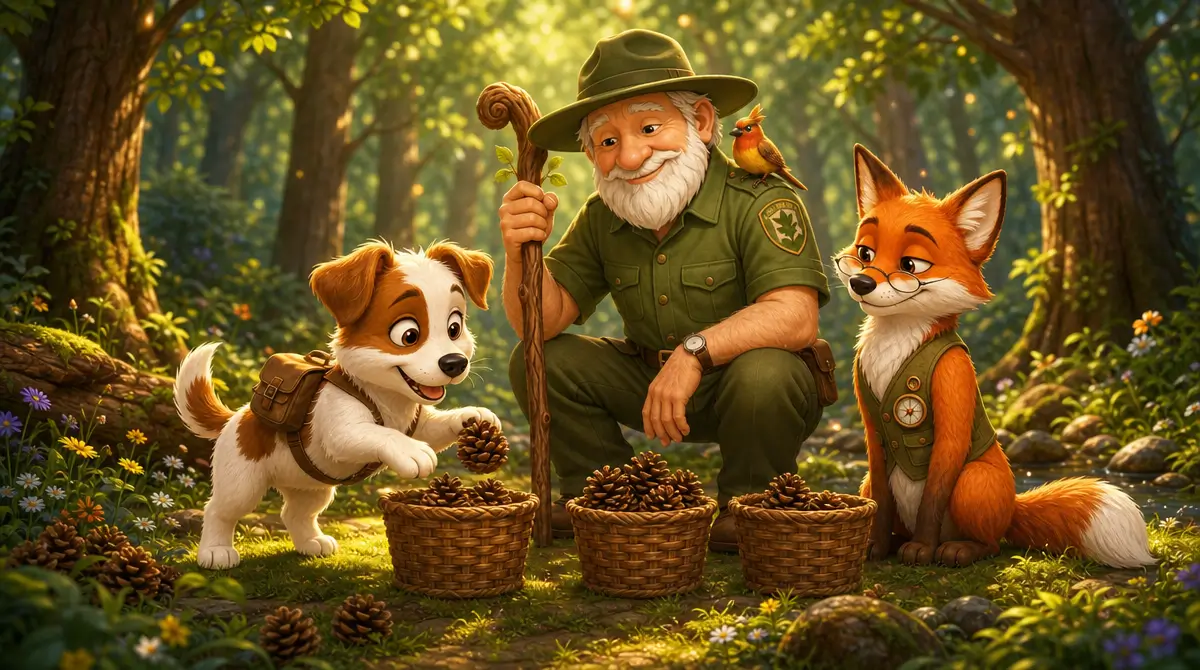
In EduBert, division is the world of the Forest — the most mysterious of the four and deliberately last on the route. There your child practises exactly the model didactics says to start with: sharing out equally. EduBert splits supplies and hands out finds fairly between friends — with Ranger Boris, Fred the Fox, Mama Bear, Celina the Owl and Derek the Woodpecker along for the trip. The Forest starts with sharing out equally, and deeper in the woods your child also practises packing into equal groups ("how many in each?") — grouping, the second meaning of division, in exactly the order this article introduces them. Difficulty rises gradually, and a mistake is an invitation to try again, not a punishment.
For short division refreshers (and any other operation) there's also the Training Meadow — no storyline, just practice in a chosen format. The first level of the Forest is free, so your child can try equal sharing at zero risk while you check whether the format fits.
Frequently asked questions
When is a child ready for division? For sharing equally — practically always; it's natural play even for a five-year-old. For division as a written operation — once they understand equal groups and know at least the beginnings of multiplication. Formally, school introduces division around third grade.
Should we wait until the times tables are fully mastered? For sharing — no waiting needed; it requires nothing. Division "with numbers" is best grown alongside the tables, in fact pairs: 3 × 4 = 12, so 12 ÷ 3 = 4. The two operations reinforce each other — there's no need to wait for a complete times table.
How do I explain division to a five-year-old? Without the symbol and without the word "operation": "share these so everyone gets the same". Dealing one at a time into bowls or onto saucers is division — in the version a five-year-old understands with their whole body.
What about remainders? Choose remainder-free numbers at first. When a remainder appears by itself, name it calmly ("two left over — that's the remainder") and return to even examples. Formal division with remainders is school material, not a home priority.
My child deals one at a time and recounts everything from scratch — isn't that too slow? It isn't "too slow" — it's exactly the right stage. Dealing one by one and recounting is the foundation on which faster thinking grows by itself ("if 3 groups of 4 make 12, I just know"). Forcing speed knocks a child out of understanding; the strategy will speed up on its own when it's ripe.
What's the difference between "share between 3 people" and "groups of 3"? Those are the two meanings of division. "Between 3 people" = sharing: we know the number of parts, we're finding how many in each. "Groups of 3" = grouping: we know the group size, we're finding how many groups. Same notation, different mental move — which is why we practise them separately at first, starting with sharing.
Division doesn't have to be the bogeyman of maths. It begins with an activity your child loves and understands — fair sharing — and ends with a sign that merely writes it down. Sharing, the two meanings, the bridge to multiplication, remainders without panic: in that order the fourth operation turns out to be the closing chapter of a familiar story, not a new opponent. You'll find the whole story — four worlds, four operations — in our tour of the four worlds of EduBert. And if you'd like your child to try equal sharing inside an adventure, the first level of the Forest is free — explore it together and see if it's a fit.
Sources
- NRICH (University of Cambridge), "Multiplication and Division: Age 5–7" — activities and progression for early multiplicative and division thinking: https://nrich.maths.org/multiplication-and-division-age-5-7
- "Development of children's informal understanding of division through sharing" (Early Childhood Research Quarterly) — research on how children's fair sharing becomes the basis of understanding division: https://www.sciencedirect.com/science/article/abs/pii/S0885200621001575
- Empson, S. B., "Equal Sharing and Shared Meaning: The Development of Fraction Concepts in a First-Grade Classroom" (Cognition and Instruction) — classic study of equal-sharing problems as the entry point to division and fractions: https://www.tandfonline.com/doi/abs/10.1207/S1532690XCI1703_3
- Jo Boaler et al., "Fluency Without Fear" (youcubed, Stanford University) — research evidence on building math-fact fluency through understanding rather than timed drill: https://www.youcubed.org/evidence/fluency-without-fear/

Written by the EduBert team
We create educational games that combine play with learning math.
Read also
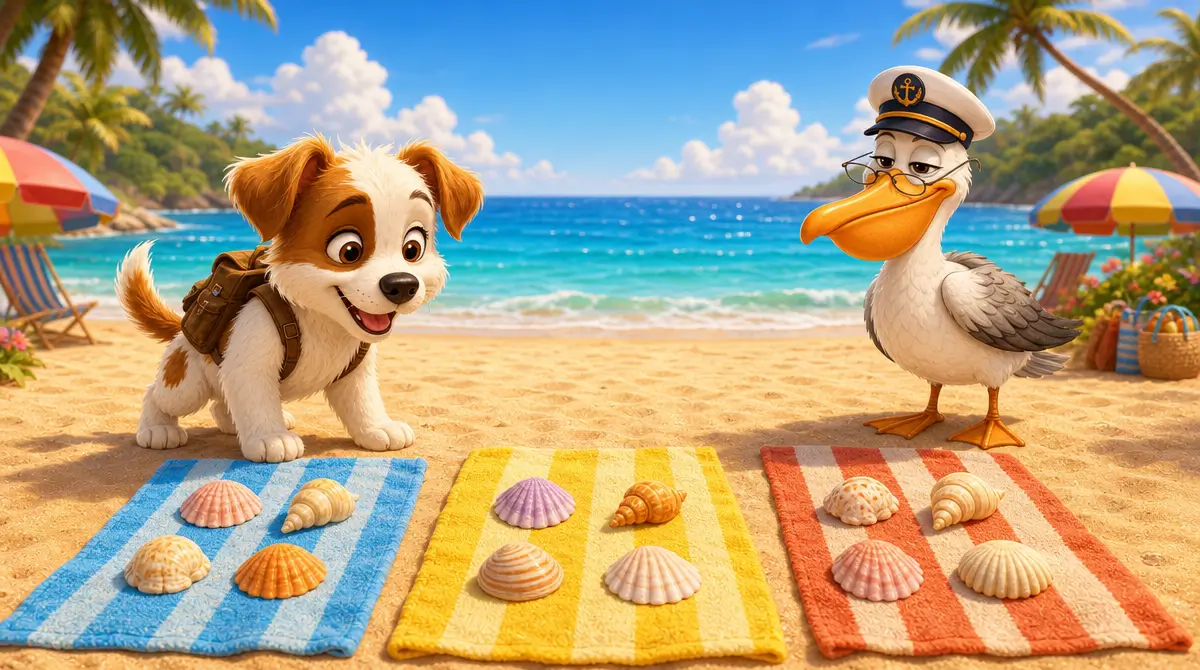
How to Teach Multiplication to Kids — from Equal Groups to Times Tables Without Tears
How to teach multiplication step by step: equal groups, skip counting and times tables without cramming. A concrete plan for parents of kids aged 5–7.
Elementary Math Curriculum (Grades 1–3) — What Your Child Needs to Know
What your child must know in math after grades 1, 2 and 3 under the Common Core — a clear year-by-year overview and how to support them at home.

The Four Worlds of EduBert — Addition, Subtraction, Multiplication and Division in One Game
Meet EduBert's four worlds: addition, subtraction, multiplication and division in one game. All available now, first level of each free to play.

Try EduBert together
Create a free account and let your child explore — the first level of every adventure is free.
Create free account →No card required — 4 adventures and the Training Meadow