5 Addition Games You Can Make at Home
Simple, proven addition games you can make at home. Zero prep, maximum fun and learning.
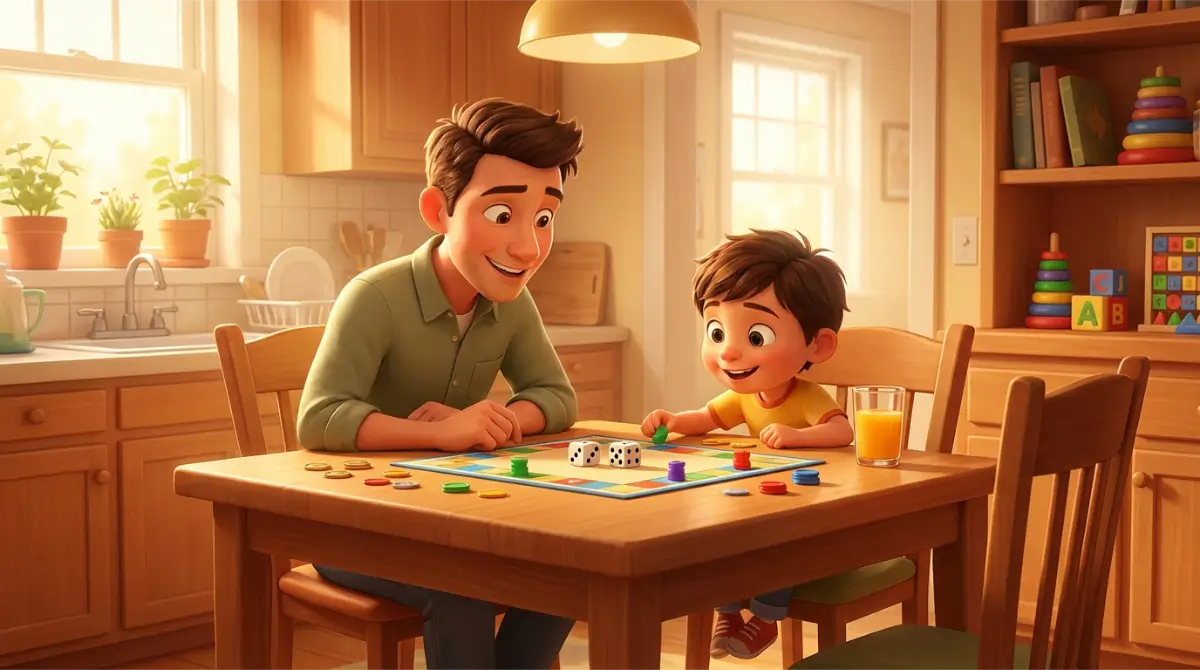
The best math exercises don't look like exercises. They look like fun. Here are 5 games you can make at home in 2 minutes — without buying anything.
Game 1: Dice Race
You need: 2 dice, paper, pencil.
Rules: Each player rolls both dice and adds the dots. Higher total wins a point. After 10 rounds, count the points. Tie? Sudden death!
Why it works: Repetition (the child adds 10+ times in one game), immediate motivation (wants to win), and randomness (even if they're weaker at counting, they can still win).
Easier version: One die — the child adds the roll to their running total. First to reach 30 wins.
Game 2: Store
You need: Pennies (10-20), household "goods" with prices.
Draw prices on sticky notes: apple = 3 cents, banana = 5 cents, cookie = 4 cents. The child "buys" two items and calculates how much to pay. You're the cashier checking if they give the right amount.
Why it works: Real context (store), tangibility (coins), and an adult role (the child feels important).
Harder version: The child has a "budget" of 10 cents and must calculate what they can afford.
Game 3: Math Memory
You need: 20 cards (10 pairs). One card has an operation (e.g., "3+4"), the other has the answer (e.g., "7").
Lay cards face-down on the table. Players take turns flipping 2 cards. If the operation matches the answer — pair won! Most pairs wins.
Why it works: Combines visual memory with math. The child repeatedly sees the same operations and answers — automatization happens naturally.
Game 4: Cup Tower
You need: 10 plastic cups, marker.
Write numbers 1-10 on the cups. Draw two random cups — the child adds the numbers. Correct answer? Stack the cup on the tower. Who builds a taller tower?
Why it works: The construction element (building the tower) gives physical satisfaction with every correct answer.
Game 5: Addition in Motion
You need: Nothing! Just floor and legs.
Draw a number line from 0 to 10 with chalk (on sidewalk) or tape (on floor). The child stands on the starting number (e.g., 4), you roll a die — the child jumps that many spaces. What number did they land on?
Why it works: Physical movement + math = double brain stimulation. Perfect for children who can't sit still.
When to Move Beyond Home Games?
Home games are great for starting out, but they have limitations: you need time and energy to prepare, the difficulty range is fixed (dice always give 1-6), and there's no automatic feedback — the child can make mistakes without noticing.
Good educational apps complement home games: they have difficulty progression, immediate feedback, and a story that engages. In EduBert, the child progresses from addition to 10 through addition to 100 across 10 scenes — with characters supporting them.
The best approach? Mix it up. Monday — dice. Tuesday — EduBert. Wednesday — store with coins. Variety is key.
Read also: How to Teach Addition · Addition to 10 — Exercises · Do Educational Games Work?

Written by the EduBert team
We create educational games that combine play with learning math.
Read also
How to Teach Your Child Addition — A Complete Guide for Parents
A practical guide for parents: how to teach your child addition step by step. Proven methods, exercises and math games for children aged 5-8.

Addition to 10 — Exercises and Games for Preschoolers
Simple, effective addition-to-10 exercises for children aged 4-6. Games with blocks, fingers and everyday objects.

Educational Games for Kids — Do They Really Work? What Research Says
A review of scientific research on the effectiveness of educational games. When do games help with math learning, and when are they a waste of time?