Counting on Fingers — Bad Habit or Natural Stage?
Should you let your child count on fingers? What does research say. When it's normal and when to intervene.
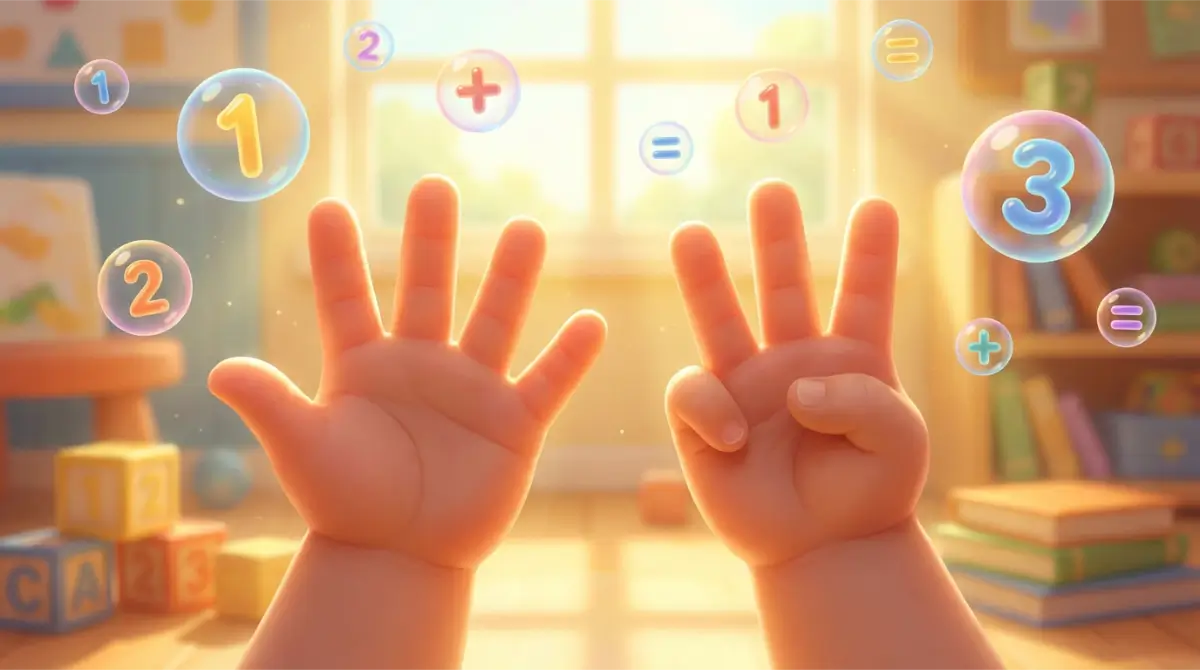
"Don't count on your fingers!" — how many times did you hear that in school? Or maybe you say it to your own child? It turns out science has a clear position on this — and it's surprising.
What Does Research Say?
Researchers from Stanford University and the University of Sheffield showed that children who count on fingers develop better numerical representation in the brain than those who were forbidden from doing so.
Fingers are a natural mathematical tool. We have 10 of them — perfect for the range where children start learning. Using fingers activates brain areas responsible for both movement and numerical processing. That's double stimulation, not a double problem.
Why Does a Child Count on Fingers?
Because they need something concrete. Abstract math (symbols on paper) is the destination, not the starting point. Fingers are a bridge between the physical world and the world of numbers.
A 5-6 year old who counts 4+3 on fingers is doing exactly what they should — going through the concrete stage before reaching abstraction. This isn't "cheating" — it's learning.
When Is It Normal?
Finger counting is completely normal and healthy at ages 4-7, especially with new, harder tasks. A child who mastered addition to 10 without fingers may return to them for addition to 20 — because that's a new, harder level.
When Should You Pay Attention?
A signal to intervene is when a child aged 8-9 still counts on fingers for simple tasks (like 3+2) that they should know by heart. This may mean they haven't internalized the basics and it's worth returning to addition to 10 exercises.
How to Help Your Child Move from Fingers to Memory?
Don't forbid. Instead, build bridges. After the child counts on fingers, ask: "What if you didn't have fingers — how much would 4+3 be?" The child will start trying from memory because it's a challenge, not a ban.
Games with time pressure (who gives the answer faster?) naturally motivate counting from memory — because fingers are slower.
Educational apps with immediate feedback help automate answers. In EduBert, the child starts by selecting answers from tiles (no need to count on fingers), and gradually transitions to a numeric keyboard — a natural bridge from concrete to abstract.
Summary
Let your child count on fingers. It's not a habit to eradicate — it's a stage to pass through. Forbidding it is like forbidding crawling because "they should be walking already." Patience and gradual challenges will do the rest.
Read also: How to Teach Addition · Addition to 10 — Exercises · Do Educational Games Work?

Written by the EduBert team
We create educational games that combine play with learning math.
Read also
How to Teach Your Child Addition — A Complete Guide for Parents
A practical guide for parents: how to teach your child addition step by step. Proven methods, exercises and math games for children aged 5-8.

Addition to 10 — Exercises and Games for Preschoolers
Simple, effective addition-to-10 exercises for children aged 4-6. Games with blocks, fingers and everyday objects.

Educational Games for Kids — Do They Really Work? What Research Says
A review of scientific research on the effectiveness of educational games. When do games help with math learning, and when are they a waste of time?