Subtraction Games at Home — 6 Playful Ways to Practise
6 simple subtraction games to play at home with dice, cards and blocks. Short, playful number practice that really teaches subtraction to kids aged 5–7.
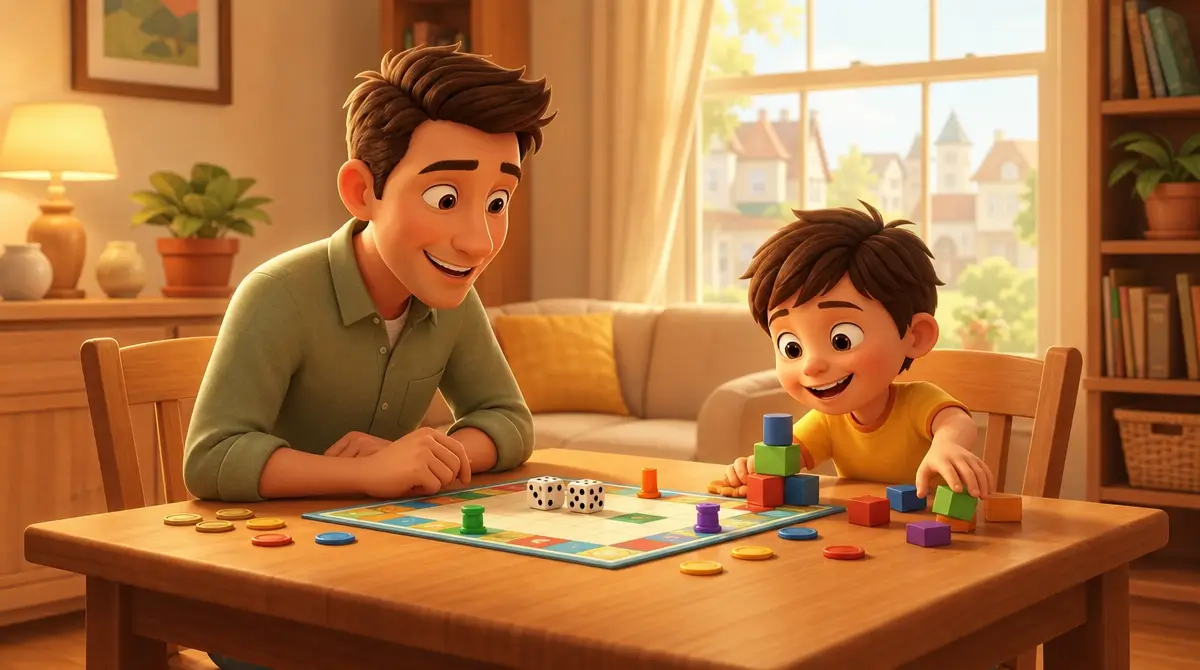
The best way to help a child enjoy subtraction is short, daily number play with things you already have: dice, cards, blocks. Classic research on numerical development found that children who played simple number board games made broad, lasting gains in number sense¹. Below are six simple subtraction games — nothing to buy — with a tip on how to match the difficulty to your child's age.
Why play teaches more effectively
In a game, a child is active, engaged, and discovers the answer instead of passively writing it down. Playful counting boosts interest in maths and supports learning more than purely formal tasks², and even a few minutes of regular play can have lasting effects. A game also naturally shows the two meanings of subtraction: taking away ("remove") and difference ("how many more"). For the method itself, see our guide on how to teach subtraction.
There's another reason: games invite productive struggle. A child searches for the answer, sometimes slips, and self-corrects — and that "almost there" moment is what builds memory best. On a worksheet a mistake is marked in red; in a game it's just the next move. Early-childhood educators make exactly this case for keeping maths playful and hands-on³. And because the same numbers come back dozens of times in different arrangements, a child cements them without the boredom of copying the same column.
6 subtraction games to try today
1. Roll two dice — "take away." Roll two dice; the child subtracts the smaller number from the larger. First to say the answer takes a token. Quick and simple, within 6. Easier: one die, subtracting from 6. Harder: three dice, subtracting one at a time.
2. The shrinking tower. Build a tower of, say, 10 blocks together. "Take away 4 — how many are left?" The child physically removes blocks and counts the rest. It's the cleanest picture of subtraction as taking away. Easier: a tower of 6. Harder: a tower of 15, taking away so you cross the ten.
3. How many did I hide? Show 10 blocks, have the child close their eyes, and hide some under a cup. "You see 6 — how many did I hide?" This builds the complement and the difference (10 − 6), the foundation for crossing ten. Harder: start from 15 or 20 blocks.
4. Cards for the difference. Pull cards 1–10 from a deck. Each player flips one; the bigger difference between the cards wins. Great for the "how many more" sense.
5. Home shop. The child "buys" toys with paper coins and gets change. Making change is subtraction at its most real (and a chance to count "how many more do I have than I need").
6. Number-line hopscotch. Chalk a 0–20 line. The child stands on a number and "hops back" by the number rolled. Subtraction becomes movement — a jump to the left. Easier: a 0–10 line. Harder: hops that cross a full ten.
What to have on hand — a little game kit
To keep play spontaneous, keep a few simple things in one box — you almost certainly have them all already:
- Two or three dice (ordinary six-sided; for older children, ten-sided too, for numbers above 6).
- A deck of cards — values 1–10 are enough; set the picture cards aside or give them your own value.
- A handful of counters — blocks, buttons, pasta. Anything you can count and "take away."
- A cup or box to hide under (for "how many did I hide?").
- Chalk or masking tape — to draw a number line on the floor.
- Paper and something to write with, for when you want to record an answer or check it with addition.
A little "kit" like this means a game starts in ten seconds, with no rummaging through drawers. Keep it within reach — the lower the barrier, the more often you'll reach for play instead of a worksheet.
How to match the difficulty
For a five-year-old, keep the numbers small (up to 5–6) and use the "take away" model with real objects. For a six- to seven-year-old, raise the range to 20 and add games that practise crossing ten (for example, "how many did I hide?" with numbers 11–20). One rule: a game should be slightly too easy, not slightly too hard — that's when a child wants to keep playing. Don't turn it into a test; frequency beats length. For how much time is enough, see how much daily math practice.
The same game grows with the child: in "the shrinking tower," a five-year-old builds a tower of 6 and takes away 2, while a seven-year-old builds one of 15 and takes 8, crossing the ten. One game, many levels.
When it helps to add an app
Playing with a parent is irreplaceable, but you don't always have 15 minutes. That's when a tool with selectable levels can help. In the City, children practise subtraction as picture-based tasks, with difficulty that rises on its own — from small numbers to crossing ten. Level 1 is free, so you can see whether it suits your child — and what full access includes is laid out in EduBert's pricing. If you're also working on addition, see the companion set of addition games at home.
Four more games to rotate
To keep it fresh, have a few variants on hand:
7. Domino difference. Draw domino tiles and find the difference between the pips on the two halves. Bigger difference takes the tile.
8. The money jar. Drop "coins" into a jar, then "take out 3" — how many are left? Taking away at its simplest, with a satisfying clink.
9. Throwing at a target. Give your child 10 balls or rolled socks to toss into a basket. They got 6 in — how many missed? That's subtraction as the complement to ten (10 − 6).
10. Race backwards. On a board game (or a drawn line), a token starts on 20 and moves back by the number rolled. First to reach 0 wins.
You don't have to play them all — pick two or three favourites and return to them. Repetition helps learning.
No-prop games — in the car and the waiting room
The best games are the ones you can play anywhere — no dice, cards, or table. They're perfect in the car, in a queue, or in a doctor's waiting room, when you just need to keep a mind busy.
11. Count down backwards. Pick a starting number (say, 15) and count back in turns: 15, 14, 13… Whoever slips or takes too long "passes." Make it harder by counting down in twos (15, 13, 11…).
12. "How much less" riddles. "I've got 12 in my head. Subtract 4. How many are left?" The child counts with nothing to look at — purely in their imagination. Then swap roles; children love setting riddles for grown-ups.
13. Numbers around us. "I see 9 cars, three drove off — how many are left?" or "There were 6 windows, one is covered — how many can you see?" The surroundings hand you numbers to subtract.
These games cost nothing and teach mental arithmetic — exactly where we're headed anyway. Keep a few up your sleeve for a boring five minutes.
Paper games — when you have pen and paper
Sometimes the best "equipment" is a plain sheet of paper. These work well at the table, in a café, or when you just need to sit for a moment:
14. Subtraction bingo. Each player draws a 3×3 grid and fills the squares with answers from 0 to 9. You read out problems ("12 − 5"), and the child crosses off the answer if they have it. First to a full row shouts "bingo!" Along the way, the child works out every problem, even ones that aren't theirs.
15. Number snake. Write a chain: "20 − 3 − 4 − 2 = ?" The child works left to right, writing the result after each subtraction. Great for practising order and "holding" a number in mind; match the snake's length to their age.
16. Colour by subtraction. Prepare a simple "by numbers" picture where each region's number is the answer to a problem (the region "13 − 6" = 7, so you colour it with number seven). The child subtracts to reveal the colours. The counting becomes a means to an end rather than the end itself — which is exactly why it pulls them in.
Paper games have one more advantage: they leave a trail. The child sees how much they've done and wants to add "just one more round."
How to talk during play
Words matter. For taking away, say it plainly: "we had 8, we take 3, that leaves…". For comparing, ask: "how many more do you have?" This links the action to the language your child will meet at school. Avoid rushing or supplying the answer — let them count, even if it takes a moment. When they slip, don't correct instantly; suggest checking with addition ("let's count it back").
Praise the method, not just the right answer: "clever, you counted on from the bigger number" or "good — you went back to the ten first." A child learns that the thinking is what matters, not raw speed. And keep your own tone easy — if you treat counting as good fun, your child will pick up the same attitude.
Common parent mistakes with games
Even a good game can put a child off if we fall into a few common traps:
- Turning the game into a test. "So, what's the answer?" in an exam voice kills the fun. Play along, don't quiz.
- Jumping in too fast. The silence while a child thinks is valuable. Count to five in your head before helping.
- Pitching it too high. If a child loses again and again, the game stops being fun. Better slightly too easy.
- Correcting every slip. Not every mistake needs fixing on the spot — sometimes it's better to finish and check the answer together, with addition.
- Sessions that run too long. Stop before the child gets bored — leave them wanting the next round.
The golden rule: it's shared play, with counting along for the ride. When a child links the game to a good moment with a parent, they ask for more — and then the learning takes care of itself.
When your child finds it hard
If you see discouragement, drop the numbers lower (to 5) and return to plain "taking away" with objects — no rush, no competition. Choose cooperative games where you win together, and set the level so success comes often. A short, successful game once a day does more than a long, frustrating session now and then.
Why play sticks
When a child moves the blocks, rolls the dice and watches a group "shrink," they build a picture of subtraction a worksheet can't give. That picture stays — later, at 8 − 3, they "see" a real situation behind the symbol. Play also removes pressure: a slip in a game doesn't sting like a "wrong answer" in a notebook, so children try again more readily. And the more successful tries, the stronger the confidence — making it easier to move on to harder numbers and subtraction across ten.
It's worth remembering, too, that in a game a child repeats the operation many times and in different contexts — once as dice, once as blocks, once as change at the shop. That variety makes their understanding of subtraction flexible rather than tied to one kind of exercise. It's exactly what's missing when a child grinds through identical columns.
Subtraction in everyday moments
Not everything has to be a board "game." The best practice often happens in passing:
- At snack time: "There were 4 strawberries, you ate 1 — how many are left?" The child counts what's on the plate.
- On the stairs: go up and down counting steps forward and back — stairs are a ready-made number line.
- While tidying up: "There are 8 blocks on the floor, you put 5 in the box — how many are still out?"
- At the shop: let your child work out the change (even an estimate teaches the sense of "how much less").
These micro-questions, woven through the day, do more than one long session — because the child sees that numbers are useful. The key is a light tone: ask out of curiosity, don't "test." If your child isn't in the mood, let it go and come back another time. And now and then, swap roles — let the child make up a problem for you ("I ate 2 of 6, how many do I have?"). Inventing problems is a sign they understand subtraction, not just compute it.
Frequently asked questions
What age are these games for? Most work from age 5 with small numbers; the crossing-ten versions suit ages 6–7.
How long should we play each day? Short and regular wins — a few to a dozen minutes. One game a day in a good mood beats a long session once a week.
My child loses and gets discouraged — what do I do? Choose cooperative games (like a shared "how many did I hide?") over competition, and set the level so success is frequent.
Will games replace school learning? They won't replace it, but they support it well — building the number intuition that school can then build on.
Do I need ready-made board games? No. Dice, cards, blocks and a sheet of paper cover a dozen games. Ready-made boards can be a nice extra, but they aren't what teaches — the counting you do with them is.
How do I connect subtraction games with addition? The easiest way is checking: after each subtraction, "go back" with addition (5 are left, so 5 and 3 make 8 again). You can also play "take away one round, add on the next" — the child sees they're two sides of the same thing.
What if we only have five minutes? That's enough. One round of "how many did I hide?" or a quick countdown in the car does the job. A regular five minutes beats an occasional half-hour.
You don't need to be a teacher to teach subtraction — dice, blocks and five good-humoured minutes are enough. Pick one game from the list and play it today. And when you'd like your child to practise subtraction independently, at the right level, try the City in EduBert.
Sources
- Ramani, G. B., & Siegler, R. S. (2008). "Promoting Broad and Stable Improvements in Low-Income Children's Numerical Knowledge Through Playing Number Board Games." Child Development, 79(2), 375–394: pubmed.ncbi.nlm.nih.gov — simple number board games produce broad, lasting gains in number sense.
- Play-based mathematics activities for families, ScienceDirect: sciencedirect.com — playful, family-based maths practice supports early numeracy.
- NAEYC, "The Beauty of Early Childhood Mathematics: Playful Math = Engaged Learning": naeyc.org — the case for playful, hands-on mathematics in the early years.

Written by the EduBert team
We create educational games that combine play with learning math.
Read also
How to Teach Subtraction to Kids (Ages 5–7): A Parent's Guide
Teach your 5–7-year-old subtraction step by step: concrete-to-abstract, the two meanings of subtraction, and crossing ten. Practical methods for parents.
Addition Games at Home — 8 Ideas With Nothing to Buy
Simple, proven addition games you can make at home with dice, cards and cups. Zero prep, maximum fun and learning for kids aged 5–7.
How Much Time Should Your Child Spend on Math Each Day — A Calm Answer for Parents
How many minutes of daily math practice does a 5–7 year old need? Age-based recommendations and why consistency beats intensity.

Try EduBert together
Create a free account and let your child explore — the first level of every adventure is free.
Create free account →No card required — 4 adventures and the Training Meadow