How to Teach Your Child Addition — A Complete Guide for Parents
A practical guide for parents: how to teach your child addition step by step. Proven methods, exercises and math games for children aged 5-8.
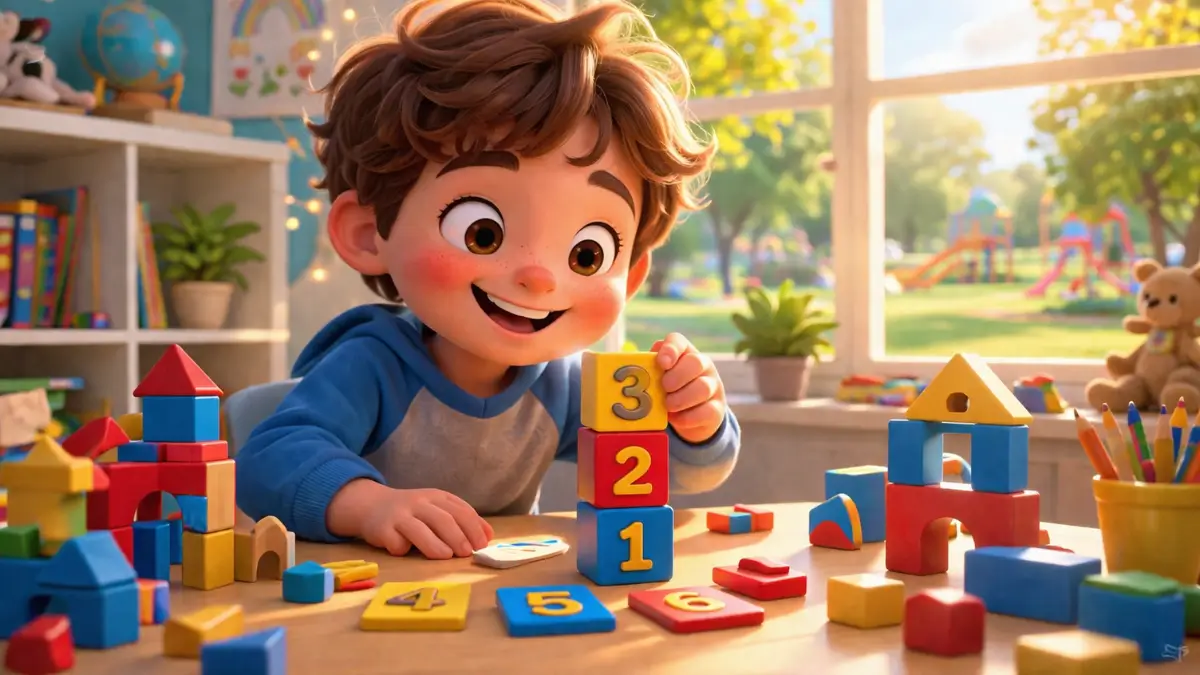
Your child is 5-6 years old and it's time for their first encounter with addition. Where do you start? Do you need to be a teacher to help? Absolutely not. In this guide, you'll find proven methods that work — tested by educators and parents alike.
When Is Your Child Ready for Addition?
Most children are ready for simple addition between ages 4 and 6. It's not about the calendar age — it's about readiness signals.
Your child is ready when they can count to 10 without mistakes, understand that "three apples" means a specific quantity (not just an abstract word), and can compare "more" and "less" using real objects.
If your child hasn't mastered these yet — don't rush. Every child has their own pace. It's better to start a month later with joy than a month earlier with frustration.
From Concrete to Abstract — The Golden Rule
Children learn math in three stages. First comes the concrete stage, where they count real objects like blocks, apples, and teddy bears. Then the pictorial stage, where they count drawn objects, dots, and symbols. Only then comes the abstract stage with numbers alone, like 3 + 2 = 5.
The number one mistake is jumping straight to stage three. A child who hasn't counted apples won't understand "3 + 2." They'll guess, and then they'll grow to hate math.
Starting exercise: Place 3 blocks on the left and 2 on the right. Ask your child to count the left pile first, then the right, then all of them together. That's addition — physical, tangible, understandable.
The Finger Method — Stage or Bad Habit?
Adding on fingers is a natural and healthy developmental stage. Research from Stanford and Oxford universities confirms that children who count on fingers develop better number sense than those who were forbidden from doing so.
Don't ban finger counting. Instead, gradually introduce alternatives. When your child counts 3 + 2 on their fingers, praise them, then ask: "What if you didn't have fingers — how would you figure it out?" This builds a bridge to abstraction.
7 Proven Methods for Teaching Addition
1. Blocks and Everyday Objects
Start with what you have at home: LEGO blocks, buttons, coins, candy. Divide them into two piles and count together. This is the foundation — if this works, everything else will follow.
2. Number Line
Draw a line on paper from 0 to 10 (later to 20). Your child places their finger on the starting number and "jumps" right by the amount they're adding. For example: start at 4, jump 3 times — land on 7. This visualization helps many children.
3. Dice
Two dice are a natural task generator for addition up to 12. Take turns rolling and adding the dots. Whoever calls out the answer first wins a point. Simple, quick, no preparation needed.
4. The "How Many Together?" Game
At the store, on a walk, in the kitchen — ask: "You see 2 pigeons on the roof and 3 on the sidewalk. How many are there together?" Math in a real-world context sticks deeper than worksheets.
5. Coins
Children love money. Give your child a handful of pennies and solve problems together. "You have 5 pennies and get 3 more. How many do you have?" Concrete, tangible, and it makes them feel "grown up."
6. Drawing
Task: "Draw 4 circles and 3 triangles. How many shapes did you draw?" Combines creativity with math. Works especially well with children who love drawing.
7. Educational Apps
Good apps combine play with learning. What matters is that the app has difficulty progression (easy to hard), gives immediate feedback (right/wrong), and doesn't punish mistakes but encourages trying again.
In EduBert — The Park Adventure, your child learns addition from 1 to 100 across 10 scenes, with a story and characters guiding them through the learning. The first level is free — worth trying before buying workbooks.
Progression: From Addition to 10 Through Addition to 100
Don't try to teach everything at once. The progression should look like this:
First, addition to 5, where the child works with very small numbers. Then addition to 10, which is the foundation of all Grade 1 math. Next, addition to 20 with crossing the tens threshold — the hardest step. And finally, addition to 100, which requires understanding tens and ones.
Each stage should take as long as the child needs. There's no schedule that says "in 3 weeks you must be at stage 2." Some children need 2 weeks for addition to 10, others need 2 months. Both are normal.
Most Common Mistakes Parents Make
Too-fast progression. The child barely mastered addition to 10, and the parent is already giving tasks up to 20. Result? Frustration and reluctance.
Comparing with other children. "Katie from kindergarten already adds to 50." Every child has their own pace. Comparison creates anxiety, not motivation.
Too much paper, not enough play. A 5-6 year old learns through play, not by sitting over a workbook. 15 minutes of block play beats 45 minutes of boring worksheets every time.
Punishing mistakes. A mistake is feedback, not failure. If your child gets it wrong — praise the attempt and show how to reach the right answer.
How Much Time Per Day?
For children aged 5-6: 10-15 minutes daily, ideally through play. For children aged 7-8: 15-20 minutes, mixing play with written exercises.
The key is consistency — 10 minutes every day yields better results than 60 minutes once a week.
Summary
Teaching addition is a marathon, not a sprint. Start with concrete objects (blocks, apples, coins), let your child count on fingers, don't rush the progression, and turn exercises into games. Your child doesn't need to be a math genius — they just need to enjoy counting.
If you're looking for a tool that combines play with learning addition, check out EduBert — The Park Adventure. 10 scenes, 100 tasks, characters that guide your child through the story. First level free.
Read also: Math in the National Curriculum · Do Educational Games Really Work? · Meet the Park Characters

Written by the EduBert team
We create educational games that combine play with learning math.
Read also
Math in the National Curriculum (Grades 1-3) — What Your Child Needs to Know
Overview of math requirements in the Polish national curriculum for grades 1-3. Addition, subtraction, multiplication, division — scope and expectations.

Educational Games for Kids — Do They Really Work? What Research Says
A review of scientific research on the effectiveness of educational games. When do games help with math learning, and when are they a waste of time?

Meet the Park Characters — Gardener Henry, Squirrel Suzie, Goose Greta, Hedgehog Jeremy and Magpie Stephanie
Every character in EduBert has their own personality and role. Meet the 5 characters who accompany your child in learning addition in the Park Adventure.