Math in the National Curriculum (Grades 1-3) — What Your Child Needs to Know
Overview of math requirements in the Polish national curriculum for grades 1-3. Addition, subtraction, multiplication, division — scope and expectations.
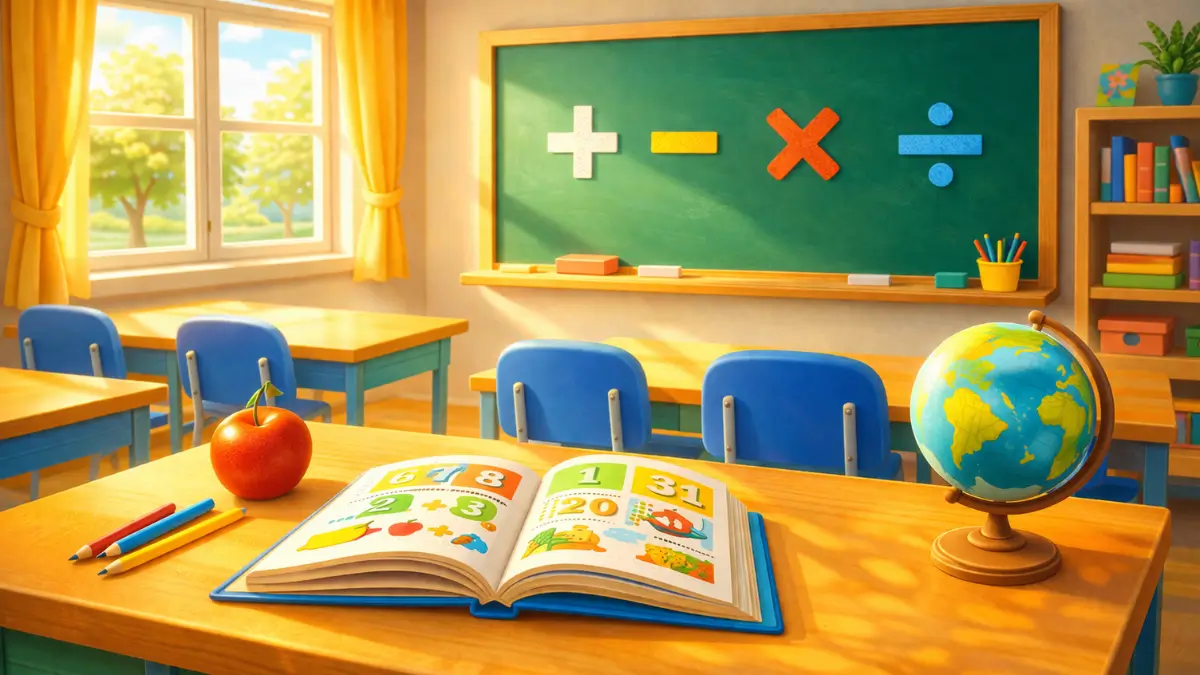
What exactly should your child know in math after Grade 1? And after Grade 3? The Polish national curriculum defines this precisely. Here's a clear overview — without educational jargon.
Grade 1 — The Foundation
In first grade, children learn four main things in math.
Addition and subtraction to 20. This is the foundation. The child should fluently add and subtract numbers up to 10, then up to 20. The key challenge is crossing the tens threshold (e.g., 8 + 5 = 13) — this is the hardest moment in Grade 1.
Number concept to 100. The child understands what numbers up to 100 mean: can read them, write them, and compare them. They don't need to add to 100 yet — but they must know that 47 is less than 52.
Measuring and comparing. Longer-shorter, heavier-lighter, more-less. Practical comparing in everyday situations.
Simple word problems. "Ola had 5 apples, she got 3 more. How many does she have now?" The child must understand the text and convert it to an operation.
Grade 2 — Expansion
Addition and subtraction to 100. This is the main challenge of Grade 2. The child must fluently operate with two-digit numbers. Understanding place value (tens and ones) is required.
Multiplication tables to 30 (multiplication by 2, 3, 4, 5). The child begins learning multiplication — but not the full table yet. Understanding that multiplication is repeated addition is key.
Division as the inverse of multiplication. Simple division: "12 divided into 3 groups — how many in each?"
Clock, calendar, money. Practical applications of math: reading hours, days of the week, months. Calculating prices at the store.
Grade 3 — Full Tables and Confidence
Addition and subtraction to 1000. Extended range. The child operates with hundreds, understands borrowing and carrying.
Full multiplication table (1-10). This is the key milestone. By the end of Grade 3, the child should know the multiplication table by heart. In practice, this requires regular practice throughout the year.
Division with remainder. "13 divided by 4 = 3 remainder 1." Understanding that not everything divides evenly.
Fractions — introduction. Half, quarter, third. At this stage it's visual and practical (divide a pizza into 4 slices), not formal.
How EduBert Covers the Curriculum
EduBert was designed with the Grades 1-3 curriculum in mind:
The Park Adventure (Addition) covers addition from 1 to 100 — from Grade 1 through Grade 2. City (Subtraction) will cover subtraction in the same range. Beach (Multiplication) will cover the multiplication table. Forest (Division) will introduce division up to 100.
Together, 4 adventures cover the full arithmetic scope of Grades 1-3. Each adventure has 10 difficulty levels and 100 tasks in 10 different formats — from simple calculation to comparing, sorting, and filling in gaps.
Details of The Park Adventure (Addition) — available now, first level free.
What Can I Do as a Parent?
You don't need to teach your child instead of school. Your role is to support and reinforce.
Weave addition and subtraction practice into everyday situations: at the store, on walks, while cooking. Practice multiplication tables regularly — 5-10 minutes daily yields better results than an hour once a week.
If your child struggles with math — don't panic. Ask the teacher which specific area needs support and focus on that. Widely available tools (worksheets, games, educational apps) can help reinforce material in an enjoyable way.
Read also: How to Teach Addition · Do Educational Games Work? · Meet the Park Characters

Written by the EduBert team
We create educational games that combine play with learning math.
Read also
How to Teach Your Child Addition — A Complete Guide for Parents
A practical guide for parents: how to teach your child addition step by step. Proven methods, exercises and math games for children aged 5-8.

Educational Games for Kids — Do They Really Work? What Research Says
A review of scientific research on the effectiveness of educational games. When do games help with math learning, and when are they a waste of time?

Meet the Park Characters — Gardener, Zuzia, Gosia, Jeremi and Stefania
Every character in EduBert has their own personality and role. Meet the 5 characters who accompany your child in learning addition in the Park Adventure.