Dyscalculia — How to Recognize and Support Your Child
What is dyscalculia, what are its signs, and what can a parent do. Practical guidance — no panic, with hope.
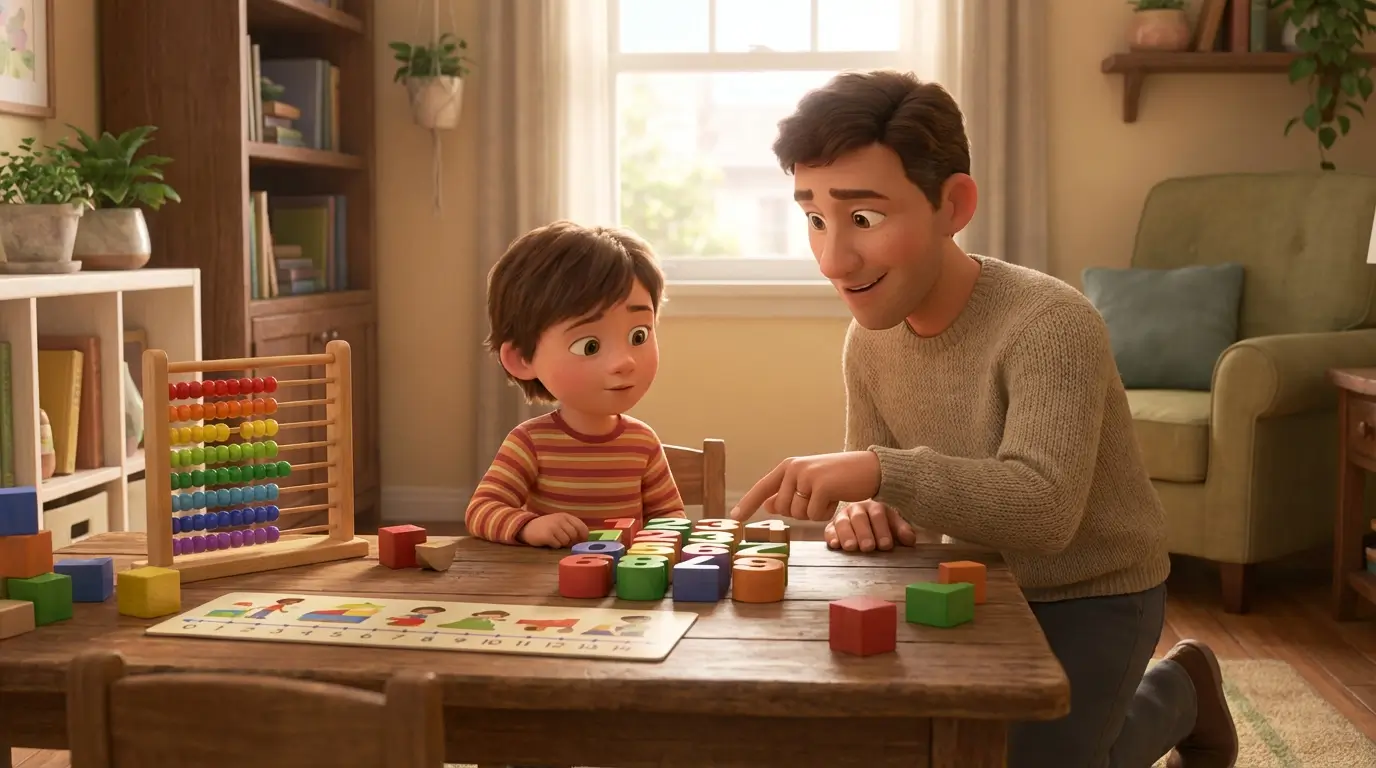
Your child struggles with math. They mix up numbers, can't remember simple additions, count on fingers much longer than their peers. Is it dyscalculia? Or do they simply need more time? This article will help you tell the difference — without panic, with concrete steps.
What Is Dyscalculia?
Dyscalculia is a specific learning disability in mathematics. It doesn't mean low intelligence — a child with dyscalculia can be bright in many areas but has difficulty understanding numbers, arithmetic operations, and mathematical concepts.
It's estimated that dyscalculia affects 3-7% of the population — similar to dyslexia. But it's diagnosed far less often because math difficulties are frequently dismissed ("not everyone needs to be good at math").
Symptoms — What to Watch For
Not every math difficulty is dyscalculia. But certain patterns should catch your attention.
In preschoolers (ages 4-6): difficulty counting to 10 (skipping numbers, changing order), trouble comparing "more/less" with concrete objects, difficulty recognizing small quantities without counting (e.g., 3 apples — has to count every time), avoiding counting games.
In grades 1-2 (ages 7-8): still counting simple sums (3+2) on fingers after many months of practice, confusing + and - signs, not understanding place value (why 23 is more than 15), difficulty remembering "doubles" (5+5, 6+6), problems with telling time and money.
In grade 3+ (ages 9+): multiplication tables remain an enormous challenge despite intensive practice, problems with estimation (doesn't know whether 47+38 is closer to 70 or 100), difficulty with multi-step problems, math anxiety or aggressive avoidance.
What Is NOT Dyscalculia?
Normal developmental signals that do NOT indicate dyscalculia:
A child counting on fingers in the first months of learning addition — that's a normal stage. A child needing more repetition than peers. A child being slower but gradually making progress. A child not liking math but managing in class.
The key difference: a child with difficulties makes progress (slowly, but makes it). A child with dyscalculia gets stuck — additional practice doesn't bring improvement despite effort.
What to Do as a Parent
Step 1: Don't Panic
Dyscalculia isn't a sentence. Children with dyscalculia can learn math — they need different methods, more time, and patient support. Many adults with dyscalculia function perfectly well — they simply learned to compensate.
Step 2: Observe and Document
Before seeing a specialist, gather observations. For 2-3 weeks, note: which tasks cause difficulty, what strategies the child uses (fingers, guessing, avoidance), how they react emotionally to math. These notes will help diagnosticians.
Step 3: Talk to the Teacher
The teacher sees your child in the context of the class and can confirm (or dispel) your concerns. Ask directly: "Do you see patterns in my child that might indicate dyscalculia?"
Step 4: Diagnosis
Dyscalculia is diagnosed by a psychologist or educational specialist at a counseling center. In Poland, testing is free at public centers or paid at private ones (with shorter wait times). It includes intelligence tests, mathematical ability assessments, and a parent interview.
Step 5: Accommodations and Support
After diagnosis, the child may receive a formal opinion entitling them to school accommodations: extra time on tests, simplified instructions, permission to use aids (number line, multiplication chart).
How to Support Your Child Daily
Whether or not your child has a formal diagnosis, these strategies help:
Concrete, concrete, concrete. Blocks, coins, tokens, fingers — for as long as possible. Don't rush the transition to abstract math.
Short, regular sessions. 10-15 minutes daily is better than an hour once a week. The brain needs regularity.
Multisensory approach. The child sees the number, hears it, touches blocks, draws it. The more senses engaged, the better the retention.
Games instead of worksheets. Educational games with immediate feedback help more than worksheets. A child with dyscalculia needs quick feedback, not a test at the end.
Patience and praising effort. Not results — effort. "I can see you're trying" matters more than "Great job, correct."
Summary
Dyscalculia isn't the end of the world. It's information that the child needs a different path — not a worse one, a different one. With the right support, patience, and good tools, every child can learn to enjoy math.
If you're looking for a tool that gives immediate feedback, has difficulty progression, and doesn't punish mistakes — check out EduBert. Designed for children who need support, not pressure.
Read also: How to Teach Addition · How Much Time for Math Daily? · Do Educational Games Work?

Written by the EduBert team
We create educational games that combine play with learning math.
Read also
How to Teach Your Child Addition — A Complete Guide for Parents
A practical guide for parents: how to teach your child addition step by step. Proven methods, exercises and math games for children aged 5-8.
How Much Time Should Your Child Spend on Math Each Day
How many minutes of daily math practice does a child need? Specific recommendations for preschoolers and grades 1-3. Consistency beats intensity.

Educational Games for Kids — Do They Really Work? What Research Says
A review of scientific research on the effectiveness of educational games. When do games help with math learning, and when are they a waste of time?